

Long March 8A Completes Debut Year With GuoWang Mission [Long March 8A Y6]
Another nine satellites for the state-backed mega-constellation were placed into low Earth orbit.

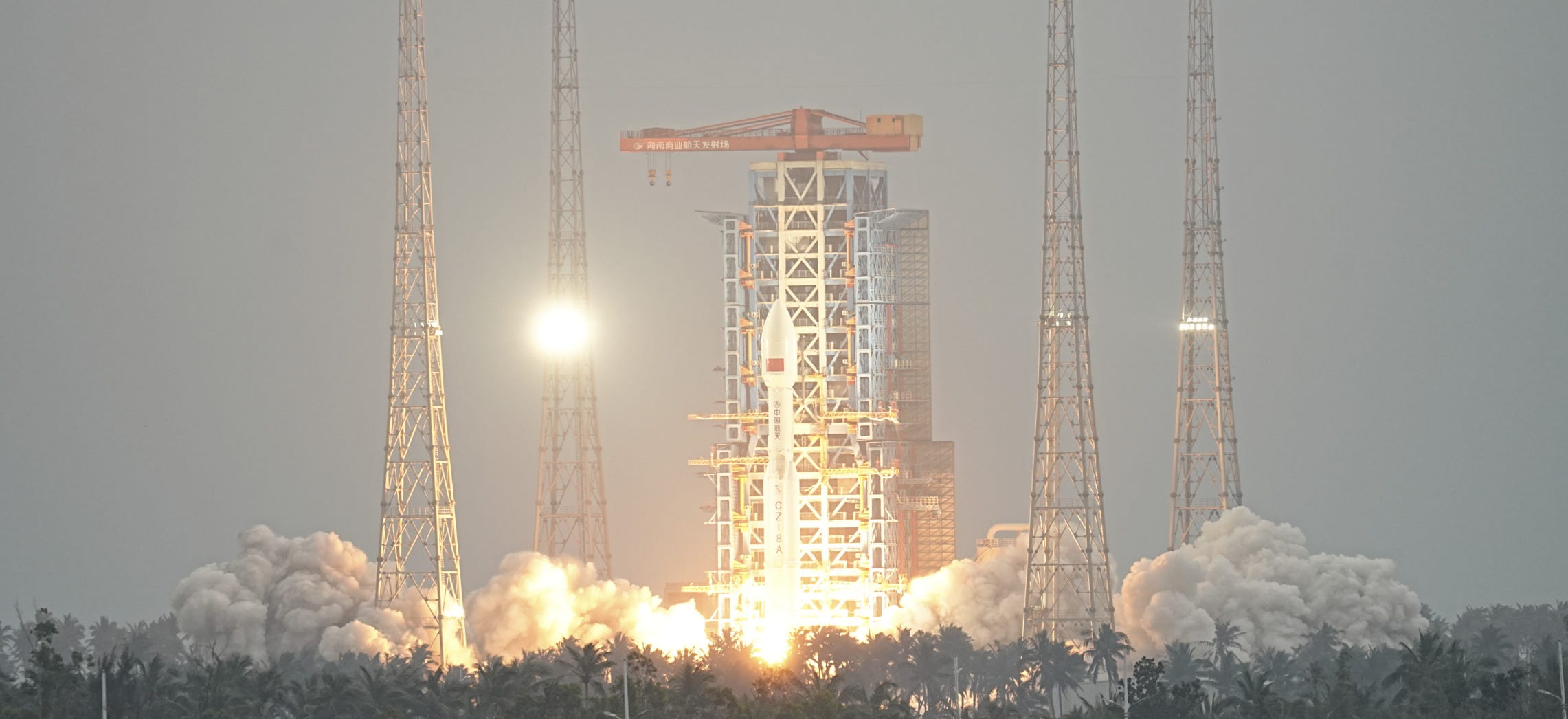
A Long March 8A soared into the early morning sky over Commercial Launch Pad 1 at the Wenchang Commercial Space Launch Site on December 26th at 07:26 am China Standard Time (December 25th at 23:26 pm Universal Coordinated Time), heading into low Earth orbit with a new group of satellites.
Atop of the rocket were the seventeenth group of GuoWang satellites, with nine inside1 the fairing. The China Academy of Space Technology says that it developed this group of satellites, which also brought the academy to over one hundred spacecraft deployed in a calendar year for the first time.
Following today’s launch, there are 136 GuoWang spacecraft in space, functioning in and heading up to their operational orbits. Over the coming years, it is planned that launches will see 310 satellites deployed in 2026, 900 in 2027, and 3,600 every year beginning in 2028 to sustain and grow the constellation. In the 2030s, up to 13,000 satellites could be in operational orbit.
The GuoWang (国网) constellation is operated by China Satellite Network Group, a state-owned enterprise and wholly backed by the Chinese government. China Satellite Network Group plans to provide worldwide internet services; for now, China-focused services are the immediate priority.
Two different satellite variants are believed to be in use for the GuoWang constellation, a larger version used on vehicles like the Long March 5B, while smaller ones are used when launched atop rockets such as the Long March 12 or Long March 6A. An electric propulsion system is used due to operational orbits above 1000 kilometers on the trapezoidal-shaped satellites, which feature two solar panels for power.
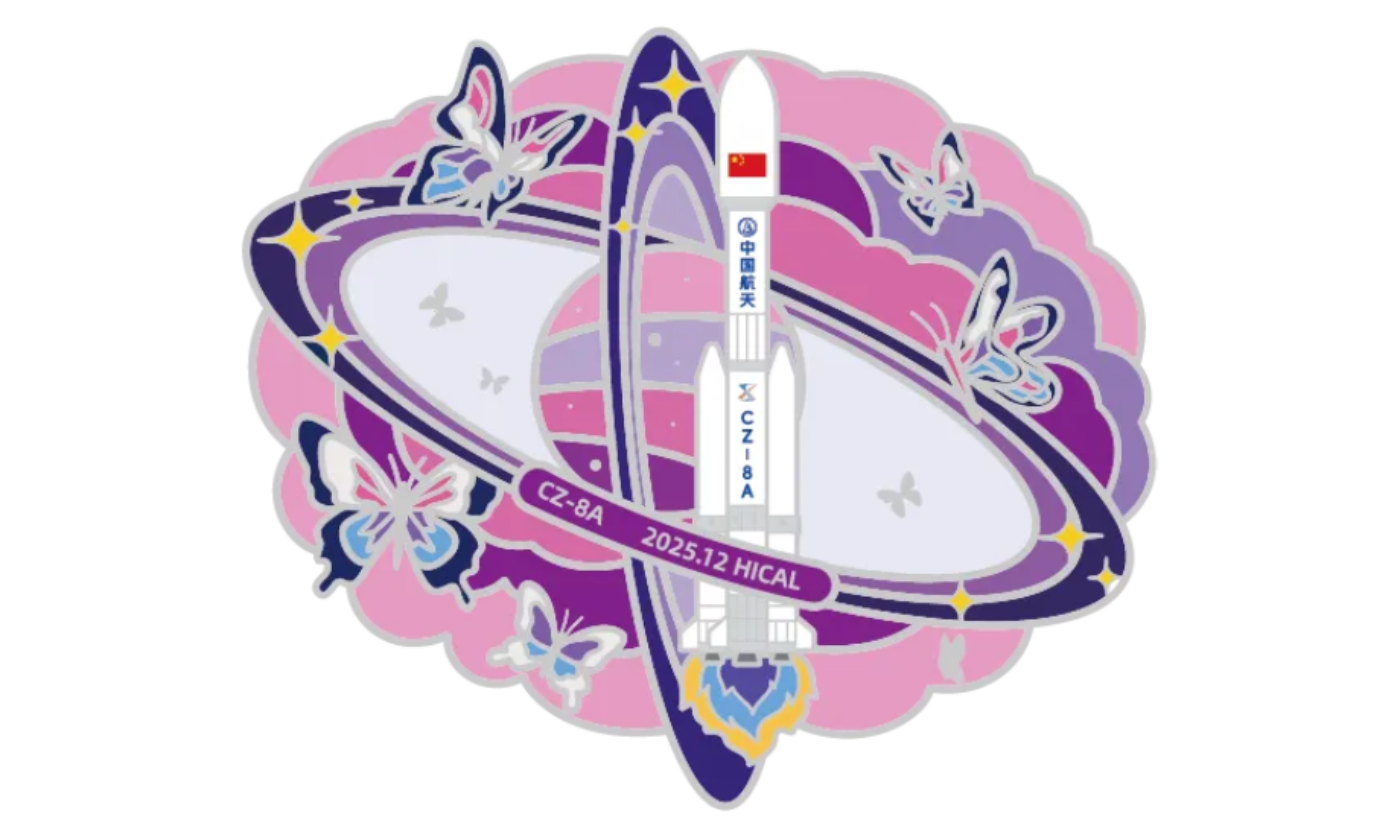
After the Long March 8A’s fifth flight, almost three weeks ago, it was expected that the next flight would have to wait until 2026, with an impressive five flights in the rocket’s debut year. For today's mission, and the sixth this year, teams from launch site operations and the launch vehicle operator exploited a continuously optimized preparation process, allowing for this launch. At an industry forum, it was recently stated that the Long March 8A could fly from Commercial Launch Pad 1 sixteen times per year with current hardware and preparation processes, with efforts underway to bring that to twenty-four times. Plans will eventually have the Long March 8 series (including the 8A2) flying fifty times per year.
With the sixth flight of 2025 completed, the China Academy of Launch Vehicle Technology declared that the Long March 8A has demonstrated its reliability and adaptability while meeting the start of high-density launch demands, with the launch process for today having taken just eight days. For 2026, the Launch Vehicle Academy shared that a recently installed parallel-launch campaign enabling hardware3 will see the Long March 8A reaching a comfortably double-digit flight rate.
This mission was the 6th launch of a Long March 8A vehicle, the 10th launch of the Long March 8 series, and the 620th launch of the Long March launch vehicle series. This was also the 90th launch from China in 2025.
Liftoff video via 航天五线谱 on Weibo as well as 我们的太空 and 海南商发 on WeChat.
Post-release update
Just over a week after launch, the Philippine Coast Guard shared that fishermen had towed one of the Long March 8A’s fairing halves to the sixteen-island municipality of Pangutaran, in the country’s South near the island of Borneo. Ahead of the launch, the Philippine Space Agency put out hazard warnings for the launch, citing those provided by China.
By the time the fairing half made it to the ocean’s surface, it was inert, having performed its job of protecting the nine GuoWang satellites within the atmosphere. Within China, enterprising individuals (sometimes even launch providers) have quickly retrieved fairing halves to make an outdoor canopy.


Check out the previous Long March 8A launch
GuoWang Becomes China's Largest Constellation for Second Time With Wenchang Mission [Long March 8A Y5]
![GuoWang Becomes China's Largest Constellation for Second Time With Wenchang Mission [Long March 8A Y5]](https://substackcdn.com/image/fetch/$s_!2pjo!,w_1300,h_650,c_fill,f_webp,q_auto:good,fl_progressive:steep,g_auto/https%3A%2F%2Fsubstack-post-media.s3.amazonaws.com%2Fpublic%2Fimages%2Fd91fd0a5-0257-42b0-a8c7-67c7cf3c5603_6773x3024.jpeg)
From Commercial Launch Pad 1 at the Wenchang Commercial Space Launch Site, a Long March 8A lifted off at 15:53 pm China Standard Time (07:53 am Universal Coordinated Time) on December 6th, flying into low Earth orbi…
What is the Long March 8A?
This section is for those less familiar with China’s Long March series of launch vehicles.
The Long March 8A is an improved and more cost-efficient upgrade of the Long March 8 and the future workhorse of its developer, the China Academy of Launch Vehicle Technology. The vehicle utilizes a two-and-a-half-stage design and is fuelled by rocket-grade kerosene and liquid oxygen in its first-stage and boosters along with liquid hydrogen and liquid oxygen in the second-stage.
The payload capacity of the launch vehicle is currently as follows:
9,800 kilograms to low Earth orbit
7,000 kilograms to a 700-kilometer sun-synchronous orbit
6,800 kilograms to a 900-kilometer sun-synchronous orbit
3,500 kilograms to geostationary transfer orbit
The Long March 8A’s boosters and first-stage are powered by YF-100 engines, with two engines on the first stage and one on each of the two boosters, generating a combined thrust of 490 tons at liftoff. The second-stage is equipped with two YF-75DA engines, which produce 20 tons of thrust.
On the launchpad, the core alone Long March 8A stands at 50.5 meters tall and weighs 371,000 kilograms when fully fuelled. The first and second-stage have a diameter of 3.35 meters, the two boosters have a diameter of 2.25 meters, while the fairing has a diameter of 4.2 or 5.2 meters.
Currently, the Long March 8A is flown from the Wenchang Space Launch Site and the Wenchang Commercial Space Launch Site, both on the east coast of Hainan province.


Every Long March 8A launch has carried nine GuoWang satellites:
It should be noted that the ‘base’ Long March 8 has not flown since March, with some hardware being sighted in a non-launch-preparation state.
This includes assembly cells for moving the Long March 8A’s first-stage and boosters from their vertical storage position onto a transportation stand for joining together and a move to the launch pad. A similar cell exists to place the second-stage onto its interstage.