

Reusable Long March 10B Debut Flight Expected No Earlier Than April 28th
Testing at Commercial Launch Pad 2 during the month has been successful, and now the reusable launch vehicle could fly as soon as a week from today.

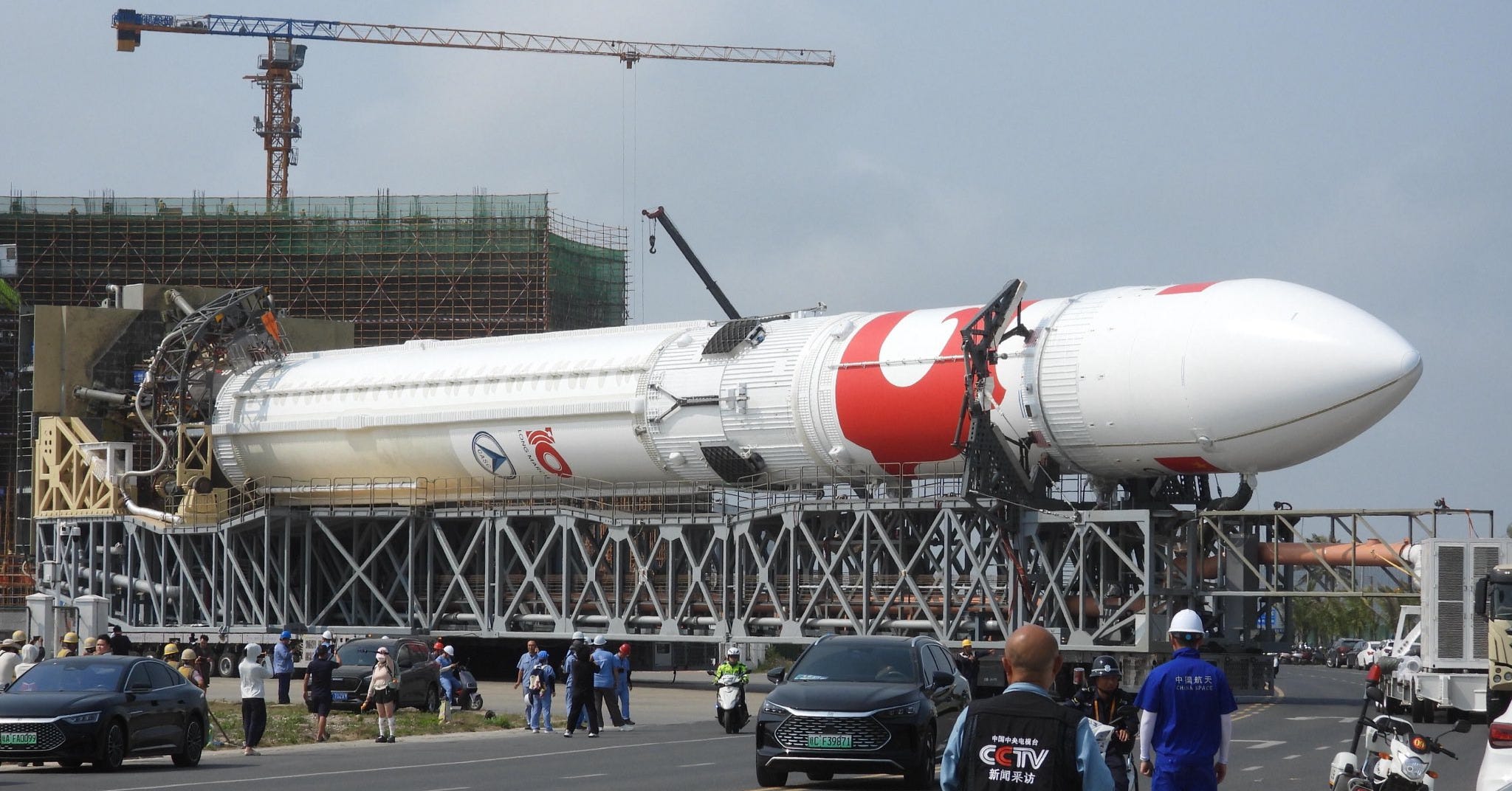
Earlier this month, the first Long March 10B launch vehicle rolled out from its integration building at the Wenchang Commercial Space Launch Site for final tests atop of Commercial Launch Pad 2 with its transporter-erector, before a launch at the end of April.
In the days after arriving, a wet dress rehearsal of the launch countdown took place, having both the first and second stages fully loaded with propellant, to prove that rocket-grade kerosene1, liquid methane2, and liquid oxygen3 could be safely loaded following separate tests in previous months. The testing concluded as a success.
What was not performed at the launch pad was a static fire. That did not actually need to be conducted, thanks to two firings of the Long March 10 series static fire test article in August and September 2025 with seven YF-100K engines installed. For those unaware, the Long March 10B’s first-stage is common to other members of the Long March 10 series, being the Long March 10A4 and the Long March 10 Moon rocket5.
After the wet dress rehearsal, the Long March 10B was taken off of Commercial Launch Pad 2 and rolled back to integration facilities. It is expected that the rollback was to retrieve the vehicle’s payload, as it cannot be lifted atop of it on the launch pad and it would be risky to include before it if testing went awry.
At the same time as the rollback, in preparation for flight, hazard notices were filed for a launch flying south-east from the Wenchang Commercial Launch Site between April 28th and 30th. Those notices include a sizable area about 550 kilometers downrange, much closer than expendable vehicles from the site, and indicates where the first-stage booster may be recovered.
A key piece of hardware that will need to be present in the hazard areas for the launch is the autonomous Long March 10 series booster-catching ship ‘Linghangzhe (领航者)’, which took part in a catch simulation with the Long March 10A test booster back on February 11th. At present, the autonomous ship is moored near Shantou (汕头市), Guangdong (广东) province.
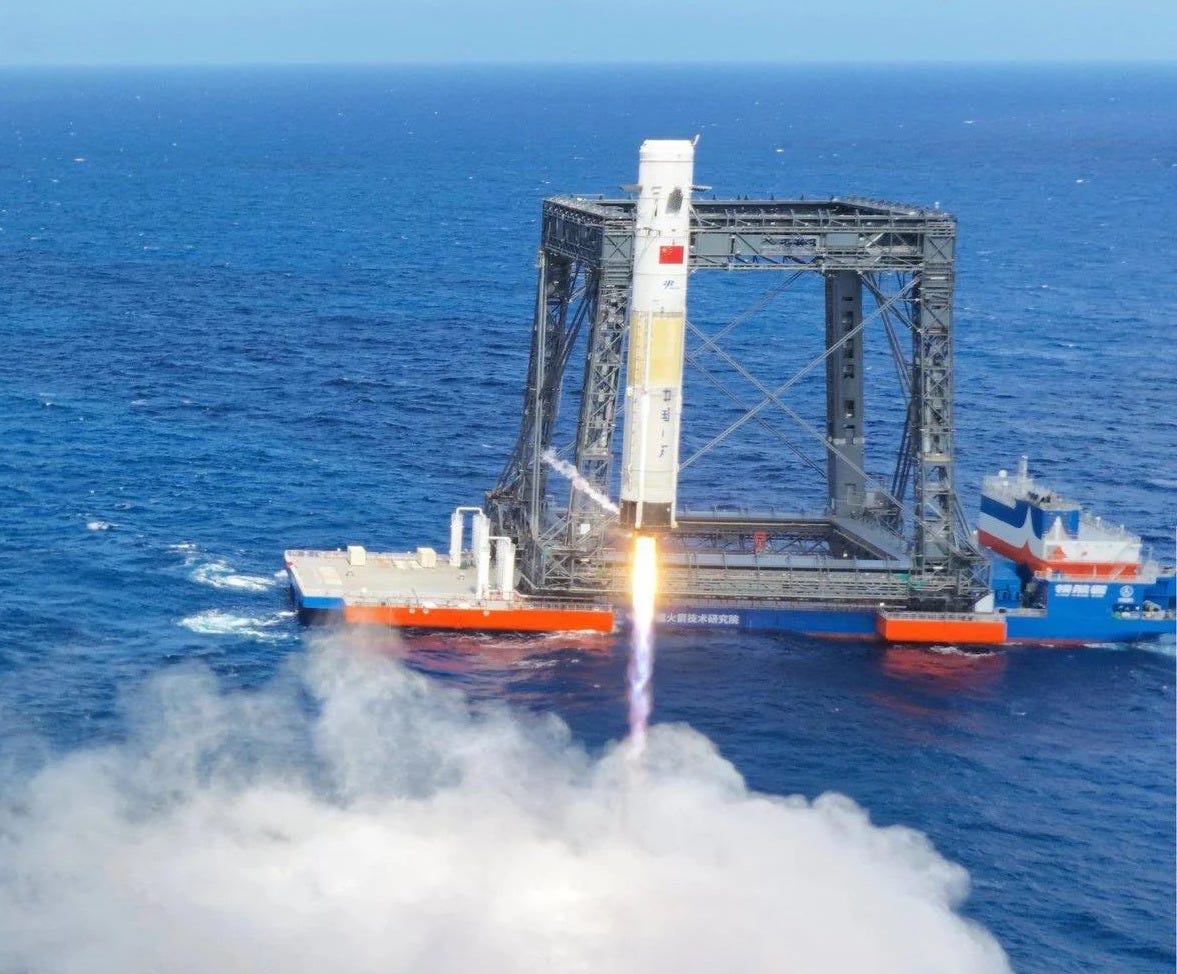
When the Long March 10B does launch, it will be the China Academy of Launch Vehicle Technology’s first attempt at recovering a stage of a partially reusable launch vehicle, as well as the third attempt in China after LandSpace with its Zhuque-3 and Shanghai Academy of Spaceflight Technology’s Long March 12A. It will also be the fifth different Chinese launch vehicle that is planned to be reusable, following the previously mentioned two alongside CAS Space’s Kinetica-2, reusable by 2028, and Space Pioneer’s Tianlong-3, to be reusable after a handful of flights.
If the Long March 10B’s first-stage booster is caught on ‘Linghangzhe’, it is unlikely to be reflown. The China Academy of Launch Vehicle Technology, and the China Aerospace Science and Technology Corporation at large, will be eager to study how the booster fared during its flight, what systems worked well, and what needs improvement.
In the weeks after the Long March 10B’s flight, a Long March 10A may deliver an experimental lunar satellite on its maiden outing, followed by the Mengzhou-1 mission to the Tiangong Space Station as soon as September. Those three flights, if not more, will all be using near-identical first first-stages6, building flight data ahead of the tri-core Long March 10 Moon rockets’ introduction next year.
Fuel for the first-stage.
Fuel for the second-stage.
Oxidizer for both the first and second stages.
Also a single-core two-stage variant, with a YF-100M powered second-stage, able to put around 14,000 kilograms into low Earth orbit.
A tri-core three-stage variant able to send up to 27,000 kilograms towards the Moon.
Attachment points to the second-stage are different and requires some adjustments to the interstage.