

Third Gravity-1 Rocket Being Prepared for Constellation-Carrying Flight, Reports Say
Orienspace’s sizable solid-fuelled rocket is moving toward another trip into Earth orbit with its first significant payload.

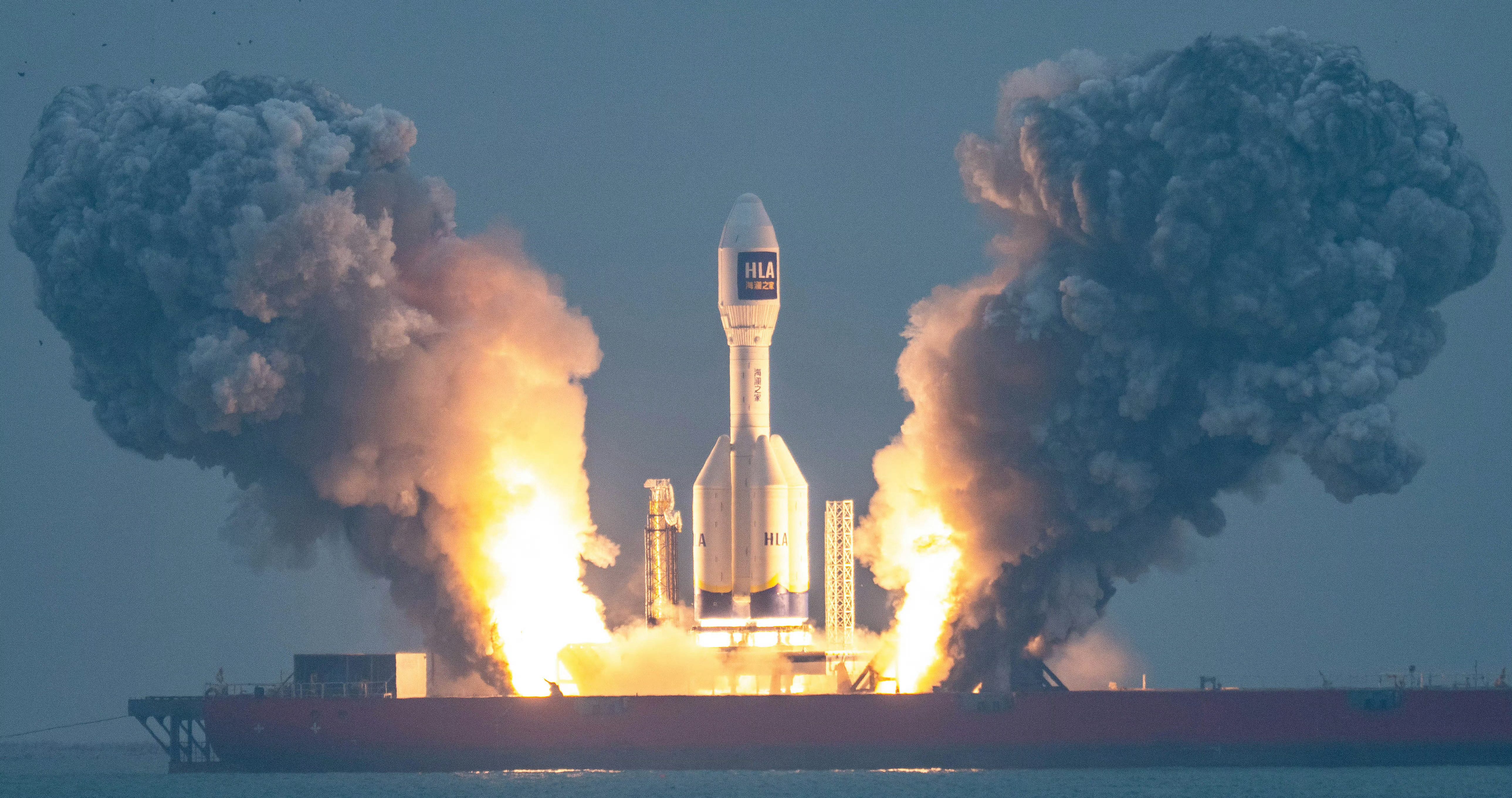
In an effort to eliminate long gaps between missions while working toward a desired quarterly cadence, at the Haiyang Oriental Spaceport (海阳东方航天港), on the south coast of Shandong (山东) province facing the Yellow Sea, China News (中国新闻网) reported on February 17th that late pre-flight preparations are underway to move Orienspace’s Gravity-1 solid-fuelled rocket toward launch.
According to information shared by launch teams just before the Spring Festival (春节), running from February 15th to 23rd, the motors that compose the launch vehicle are ready for stacking. After which, the third Gravity-1 mission will retrieve its payloads and be moved onto a launch ship.
The payloads and customer for the upcoming mission are not known, but a Xinhua report from last month highlighted Orienspace was actively promoting a ‘one-rocket thirty-satellite’ flight, with each of those satellites suggested to be 100 kilograms each. Orienspace’s Deputy Director of Haiyang Launch Vehicle Assembly and Testing, Wang Wuqin (王武钦), has been informed of a single-customer multi-satellite flight too, with him vaguely speaking of the cost advantages to the customer of launching entire constellation spacecraft groups to China News.
As Gravity-1 has a payload capacity of up to 6,500 kilograms to low Earth or 4,200 kilograms to a 500-kilometer sun-synchronous orbit, the launch vehicle may fly into a high low Earth orbit1.
At the time of publication, no hazard notices suggesting an imminent Gravity-1 flight have appeared. Additionally, the launch ship that has supported previous missions is heading back to Haiyang for post-flight inspections following a Jielong-3 launch in the South China Sea on February 12th.
If Gravity-1’s upcoming mission is successful, company management expects the vehicle to fly two more times this year. All are said to have had their payload capacity ‘fully’ booked. With the optimistic launch target, Orienspace may have overcome its internal struggles that resulted in an almost two-year gap between flights, along with a transition to simultaneous flight preparations.
In the Xinhua report, Peng Haomin (彭昊旻), Vice President of Orienspace, said that relevant authorities can optimize launch approval processes to allow her and other enterprises to achieve a high-frequency flight cadence necessary to deploy planned mega-constellations. She also encouraged ‘competent’ authorities to improve risk-sharing plans for high-cost technology development.
Speaking with China News, Peng revealed that Orienspace plans to be listed on one of China’s stock exchanges via an initial public offering, following other launch companies like LandSpace and CAS Space, while retaining a focus on technology. Regarding the upcoming year for Orienspace and commercial space enterprises, the Vice President shared:
“2026 will be the year that truly validates the commercial logic of space ventures. As a commercial rocket company, we will continue advancing toward large-scale operations to undertake the strategic mission of deploying massive low-Earth orbit internet constellations. Whoever can make substantial achievements in this area will gain a competitive advantage.”
If there are any problems with this translation please reach out and correct me.
One that would take an unpowered spacecraft or rocket stages years or decades to decay out of. Gravity-1’s final stage does have three-directional blocks of attitude control thrusters.