

Three Reusable Rockets Complete Tests, Assembly Ahead of 2026 Flights
iSpace and Galactic Energy didn't fly in 2025 and are pushing ahead for next year, joined by newcomer Astronstone.

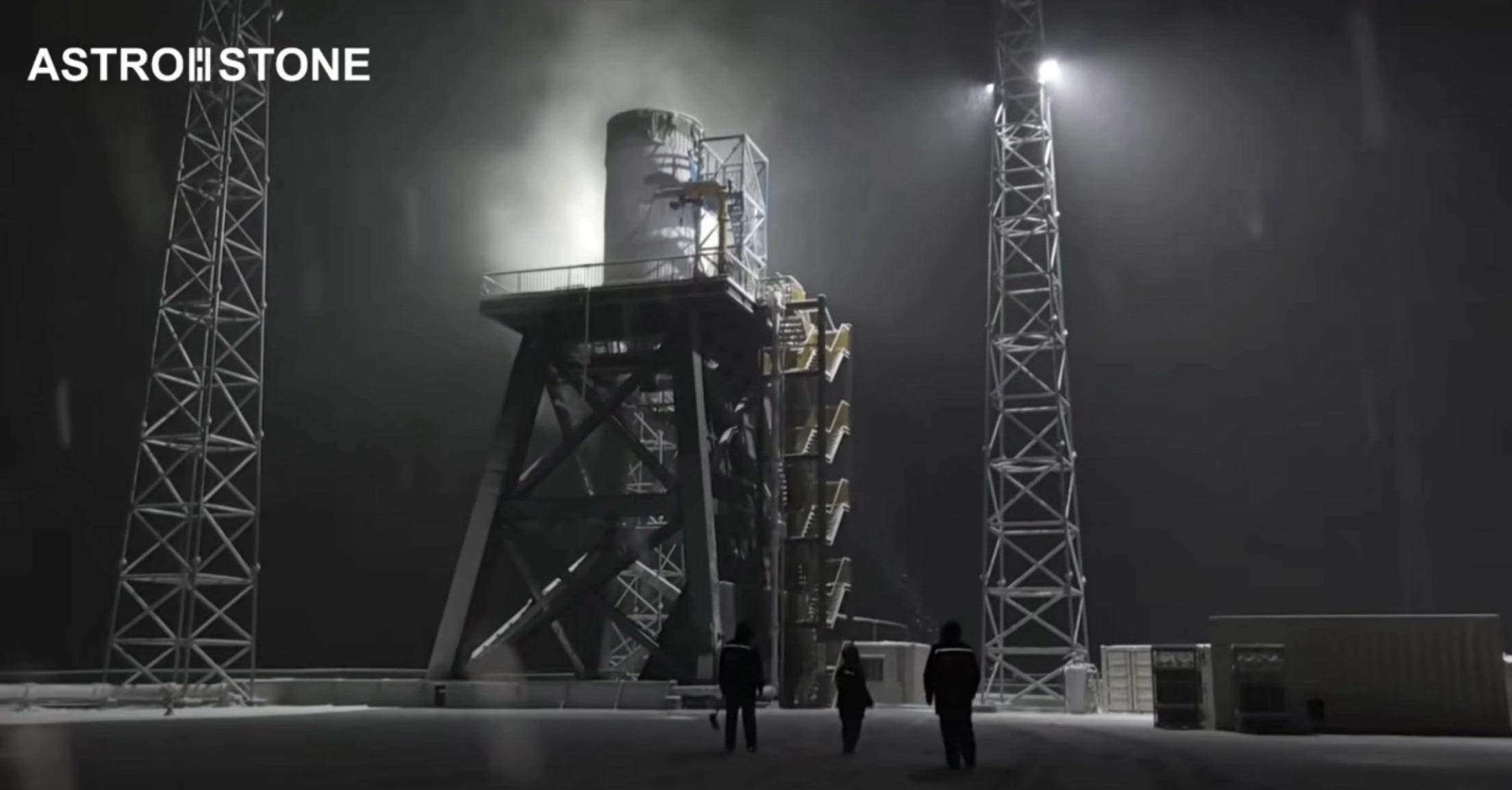
Despite 2025 coming to a conclusion, the efforts of Chinese enterprises to develop and operate reusable rockets continued to the very end, ahead of a busy 2026.
Back on December 22nd, Astronstone (宇石空间) shared that the second-stage of its two-stage partially-reusable launch vehicle AS-11 had been fired up for the first time. For the test, the 4.2-meter-diameter stainless steel rocket stage had its liquid methane and liquid oxygen propellant tanks fully loaded, before Jiuzhou Yunjian’s (九州云箭) Longyun (龙云) engine fired up, generating 80 tons of thrust for an undisclosed amount of time.
Astronstone hailed the test firing as a success for the development of AS-1, saying it verified three key parts for the launch vehicle. The first was stated to be the company’s optimization of interfaces and connections across the stage compared to other members of the industry. Another verified piece was the second-stage’s common dome design, proving it can withstand the engine’s thrust, between its two propellant tanks, said to be China’s first stainless steel common dome. A final part was related to the Longyun engine, as Astronstone said they had proven engine pre-cooling processes necessary for multiple in-space burns.
AS-1’s first second-stage firing, also the company’s first, did not utilize a facility owned by the company. Instead, the second-stage was sent to Deep Blue Aerospace’s first-stage test stand, also used for Nebula-1. For AS-1, Deep Blue says they upgraded their test facility to support the 4.2-meter-wide rocket stage and necessary systems for handling liquid methane.
Earlier in the month, Astronstone tested a basic version of its first-stage booster catch tower arms while gaining new funding for a proper production facility. AS-1’s first-stage is said to be far along in production, but images of it are yet to be shared, for a debut flight as soon as late 2026.
Meanwhile, on December 29th, iSpace announced that it had tested another part of its partially reusable Hyperbola-3 launch vehicle2, via various shock tests of a landing leg. Those tests, of which there were sixteen, simulated landing conditions on a drone ship at sea downrange from the launch site.
iSpace says that the tests gathered the data they expected to collect, allowing them to move ahead with producing the four landing legs for the first flight.
Around a week before, the company was testing a transporter-erector at the Wenchang Commercial Space Launch Site, ahead of Hyperbola-3’s debut flight sometime in 2026. Hardware shown to have been made for its include the aft end of a second-stage, propellant tanks, grid fins, and the ’Qinglan’ (清澜) drone ship.
Finally, on December 31st, Galactic Energy revealed that its partially reusable two-stage Pallas-13 launch vehicle is assembled and ready to head to the Jiuquan Satellite Launch Center for its debut flight. Hardware for the flight has been sitting around since at least May 2024, with September and November of 2025 finally seeing pre-flight static fires of both stages. The company did not provide a target date for the flight, only saying it will take place in the near future.
Ahead of that flight, Galactic Energy is working on a dedicated launch pad for Pallas-1 at Jiuquan. A timeline for its completion was also not shared, but a horizontal assembly building, flame trench and launch platform, as well as lighting diversion towers have been built, while work continues on a transporter-erector alongside propellant and commodity pipelines.


A stainless steel two-stage partially reusable launch vehicle standing 70 meters tall and 4.2 meters in diameter, burning liquid methane and liquid oxygen, capable of delivering 15,700 kilograms into orbit when expended or 10,000 kilograms when reused.
A liquid methane and liquid oxygen burning two-stage partially reusable launch vehicle planned to carry 13,600 kilograms to low Earth orbit when expended or 8,600 kilograms to low Earth orbit with first-stage reuse.
A two-stage partially reusable rocket weighing about 283,000 kilograms, when fully fuelled and with rocket-grade kerosene and liquid oxygen, capable of sending up to 8,000 kilograms into low Earth orbit.