

Zhuque-3, Long March 10B Aiming for Booster Recovery in July
The two partially reusable launch vehicles are targeting flights within days of each other, and either may herald China’s first successful booster recovery attempt.

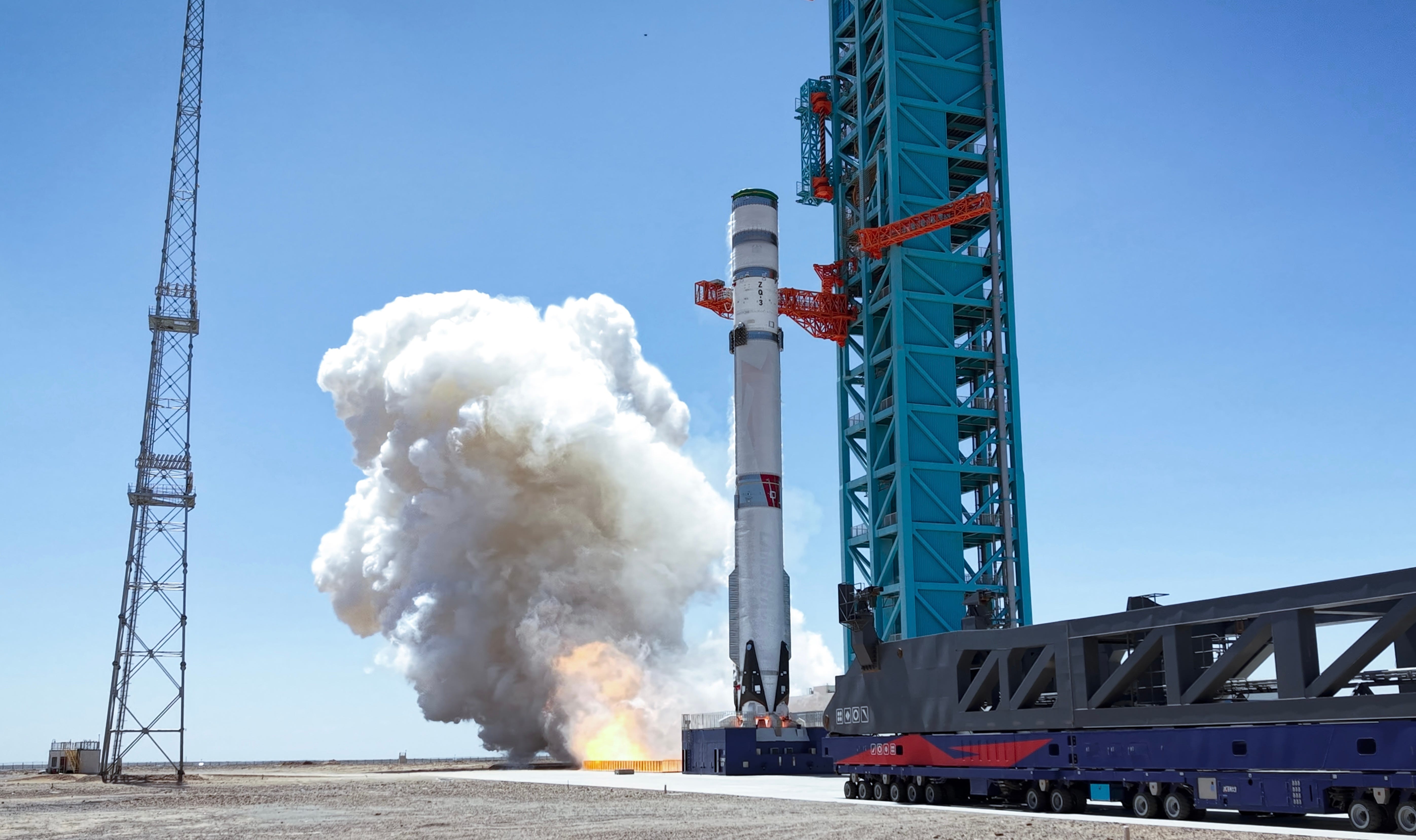
With a debut flight having occurred almost seven months ago, LandSpace’s Zhuque-3 is back on its launch pad at the Jiuquan Satellite Launch Center for a second flight and first-stage booster recovery attempt, having come incredibly close last time.
Zhuque-3 returned to its launch pad around June 19th as part of its static fire campaign. A handful of attempts to fire up the nine TQ-12A engines of the first-stage were made throughout the second half of June, being delayed for unknown reasons.
June 29th finally saw a static fire, with the nine engines generating about 769 tons of thrust for over a dozen seconds, burning liquid methane and liquid oxygen from the first-stage propellant tanks. Like its first flight vehicle static fire, the second-stage was also there and fuelled up to weigh the vehicle down.
LandSpace was quick to celebrate the recent static fire on its social media accounts, sharing:
“All key pre-launch ground verification work for the Zhuque-3 Y2 reusable launch vehicle has now been completed. The team will proceed with launch preparations according to the established plan, making full preparations for the flight mission.”
Those preparations include inspecting both stages, swapping out hardware if needed, and integrating a payload within the launch vehicle’s 5.2-meter diameter fairing. When the fairing is placed atop of Zhuque-3 a flight will be just days away.
As for when that flight may be, it is currently rumoured that LandSpace is looking at opportunities starting after the middle of July. Those will need good weather at the launch site and a landing pad located at Minqin County (民勤县), in Gansu (甘肃) province, about 390 kilometers away.
Just like Zhuque-3’s first flight, the upcoming one will also be aiming to recover the first-stage booster through controlling its descent with four grid fins and then lighting multiple engines to massively decelerate and then softly touch down. LandSpace officials are hoping that the first-stages land attempt will be perfect, through incorporating what they learned, which will be critical if the company is still seeking to reuse one by year’s end.
Static fire video via 人民网 and 空天逐梦 on Weibo.
But first, the Long March 10B?
Meanwhile, down at the Wenchang Commercial Space Launch Site, Hainan (海南) province, it appears that efforts for the Long March 10B’s maiden flight have fully resumed. Those efforts had been on hold since late April after a hydraulic issue was found with Commercial Launch Pad 2, which is now back online.
Recent activity at the commercial site has seen the launch vehicle’s massive transporter-erector taken to the launch pad alone for final joint systems checks and testing, as well as to rehearse moving it atop of many self-propelled modular transporters generally.
At the same time over in Sanya (三亚市), the autonomous Long March 10 series booster-catching ship ‘Linghangzhe (领航者)’ has entered the city’s port, after waiting offshore, to stock up on supplies at its ‘home base’ before it attempts to recover the Long March 10B’s first-stage atop of a dozen tensioned steel wires. The vessel has also been noticeably modified, as an arm is now attached to one of its corners, likely to stabilize and to passivate1 the Long March 10 series’ 5-meter-diameter boosters after a successful recovery and on trips back towards land.
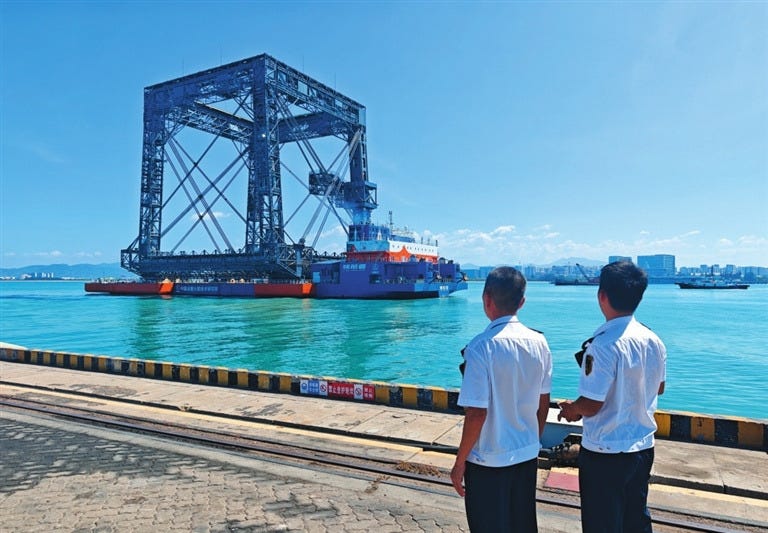
While yet to re-emerge on board its transporter-erector, hazard notices aligning with ones previously filed in April suggest that the Long March 10B could fly no earlier than July 10th. Backup dates run until July 13th at present.
Any final pre-flight tests could be quite limited, as the launch vehicle performed many tests, including a wet-dress rehearsal of a countdown, ahead of issues arising with Commercial Launch Pad 2. Although it would not be surprising if tests were repeated due to the wider importance of the Long March 10 series.
Through flying the Long March 10B first, some risk is being ‘bought’ down relative to China’s crewed lunar exploration program, primarily by demonstrating the recovery of its seven YF-100K engine-powered reusable first-stage. That first-stage is almost completely identical to the also soon-to-debut Long March 10A’s, except for second-stage interfacing hardware, which will start the Mengzhou-1 mission later this year.
Removing leftover propellants and other energetic commodities.