

Can China's Mega-Constellations Deploy Their Satellites Faster?
Between GuoWang and Qianfan, over 300 satellites have been placed into orbit via thirty launches within the past two years, but an acceleration may be possible in the near future.

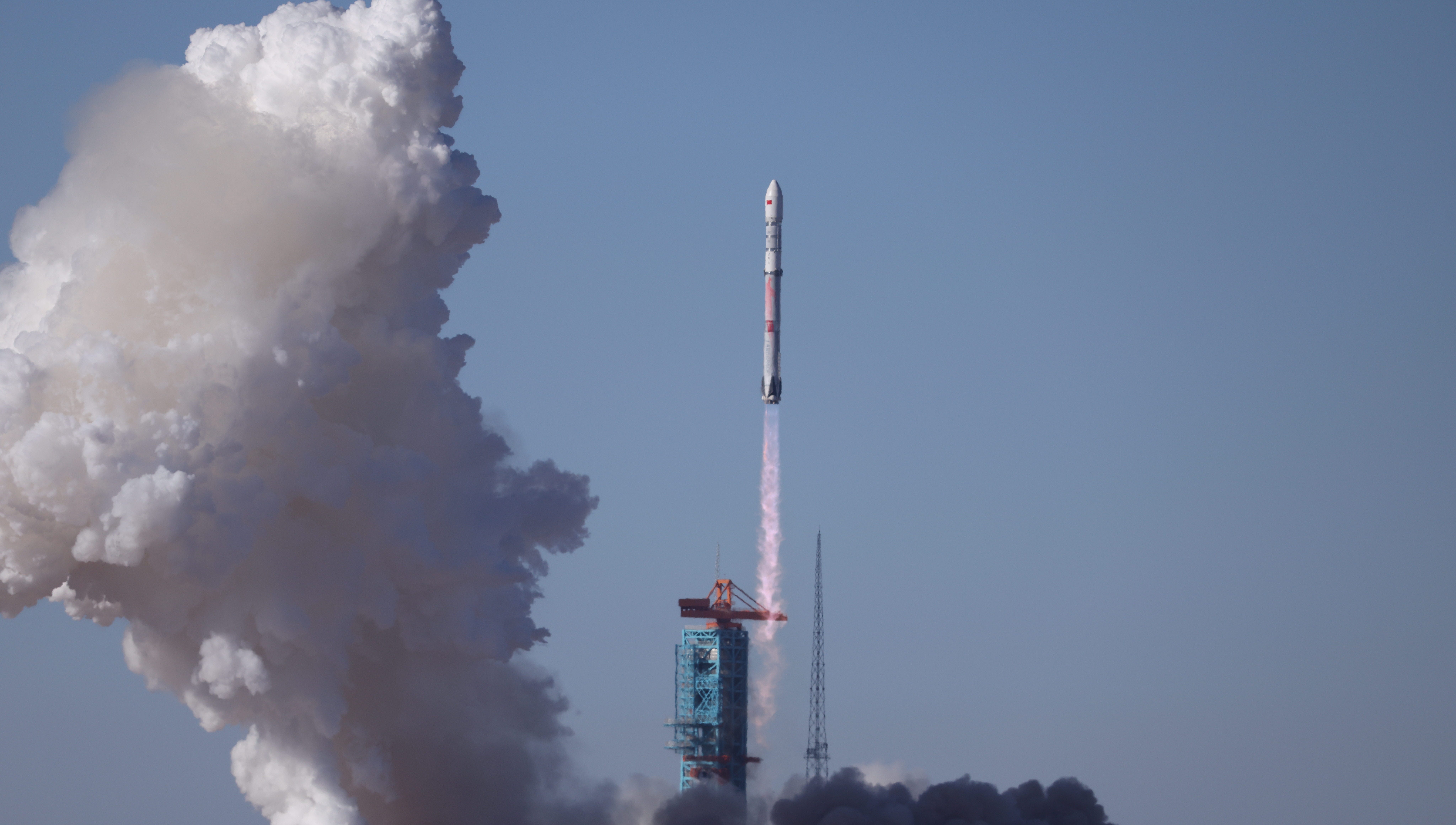
Since August 2024, China has been seriously deploying two space-based connectivity mega-constellations into low Earth orbit, known as GuoWang (国网), managed by the state-owned China Satellite Network Group (中国卫星网络集团有限公司), and Qianfan (千帆), formulated by Shanghai Spacesail Technologies Co Ltd (上海垣信卫星科技有限公司), to connect the countries remote regions, bring faster services to those with limited options, and to get ahead of the finalization and rollout of new mobile connection standards.
In building those constellations, satellites have taken dozens of rides atop of existing launch vehicles in the nation’s Long March series. For that, the following number of launch missions have placed the stated satellite counts (not including test spacecraft) into orbit:
Qianfan: 9 launches for 162 satellites, in groups of 18 each mission. (from August 2024, or over 22 months1).
GuoWang: 21 launches for 168 satellites, in groups of 5, 9, or 10 for a mission (from December 2024, or over 18 months2).
For deploying the two constellations, the Long March 8 series has been dedicated to both since February 2025, and the Long March 12 has been focused on GuoWang from August 2025. While having dedicated rides into space, Qianfan and GuoWang have been hitching rides atop of the Long March 6A, to support building its flight cadence alongside other payloads. GuoWang has also had some of its orbital shells filled by the Long March 5 series too.
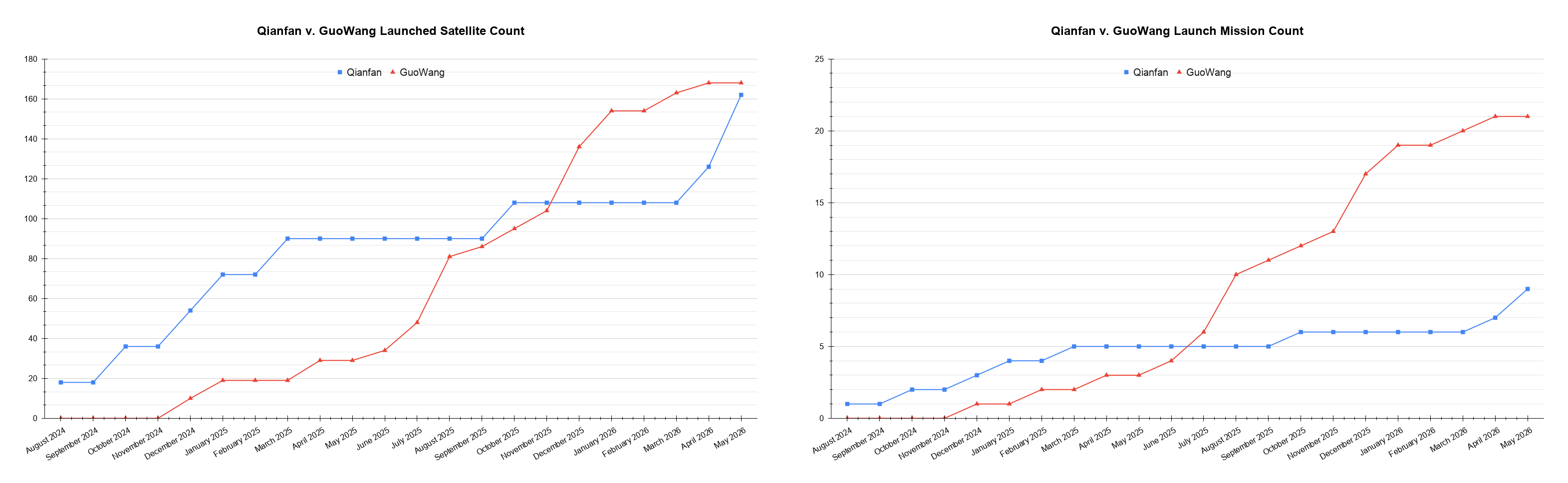
The majority of the launches being performed to deploy GuoWang satellites is a result of Qianfan satellites stranding themselves in orbit not long after deployment, which required prepared missions to be halted and shipped back to factories for fixes, followed by a return to space after a seven-month gap. Routine deployments resumed in April, picking up momentum in May.
While Qianfan was stuck on the ground and GuoWang utilized a larger number of available launches, the Western press wrote in mid-2025 that both constellations were failing to meet filed-for satellite counts, in comparison to SpaceX’s Starlink. Despite the claim, the two constellations had, by then, scaled faster than other service-equivalent constellations.
However, the idea of whether the constellations are slow in deployments opens up an interesting question: could their satellites be deployed faster?
Considering the structure of their operators and the designs of GuoWang and Qianfan3, the other effort with the best similarity is that of Amazon Leo, as the U.S. tech giant does not own a launch company, like China Satellite Network Group and Shanghai Spacesail Technologies, but has placed significant capital and effort into putting spacecraft in orbit. That has resulted in 11 launches to bring 302 satellites into low Earth orbit since April 2025 (or over 13 months4).
Deploying that number of satellites, under the combined total for Qianfan and GuoWang with a third of the needed launches, has been enabled by Amazon establishing dedicated integration facilities, solely for its constellation5, in Florida next door to three of its launch providers. Providers chosen for launch are the well-established giants United Launch Alliance, Arianespace, SpaceX, and recently orbital Blue Origin. As of writing on May 26th, deployments have occurred with the first three companies, releasing satellites in groups of 24, 27, 29, or 32, all larger than previous ones for China’s constellations.
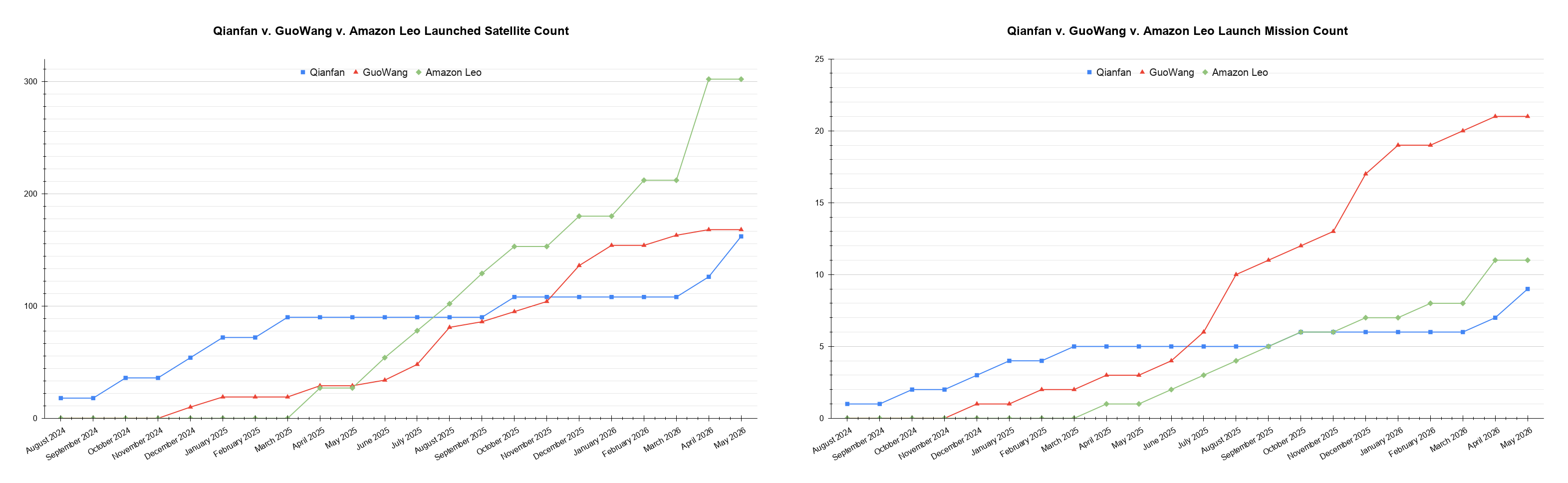
In comparison, Qianfan and GuoWang are at present only trusting state-owned launch solutions6, from three distantly separated launch sites7, under the China Aerospace Science and Technology Corporation, who have other customers they need to fulfill missions for, including government and military ones. Additionally, they are also quite decentralized on the satellite side, with both contracting out the manufacturing of spacecraft groups, leaning on China’s proven spacecraft supply chain to save costs.
Looking to the near future, Qianfan deployments are set to continue the momentum of deployments established in recent weeks, with at least a Long March 8 series and Long March 6A flights in early June. The coming months should also see the fulfillment of demonstration contracts, carrying 10 to 18 satellites, ahead of routine ones within the commercial space sector. Enterprises enlisted for that include CAS Space with Kinetica-2, Space Pioneer with Tianlong-3, alongside LandSpace with Zhuque-2E and Zhuque-3.
Near-future GuoWang deployments are harder to read, as the usual lack of known contracts and statements from China Satellite Network Group makes it difficult. Luckily, the state-backed constellation has had no observed issues in orbit to slow them down.
Efforts in establishing Qianfan and GuoWang in orbit may appear slow to date, but as Chinese launch providers, state-backed and commercial, continue to fly into orbit at a much greater rate each month and year on year, opportunities to expand satellite counts will become greater too. The ability to do so will also be supercharged by spacecraft factories being set up next to launch sites, able to produce satellites for both efforts.
Should they be deployed faster?
As great as it is to bring alternative space-based connectivity online from multiple entities across several states, placing them into orbit sustainably is even better. In an effort to bring Qianfan and GuoWang towards general operation so far, several second-stages have been found loitering in low Earth orbit following the conclusion of their launch missions.
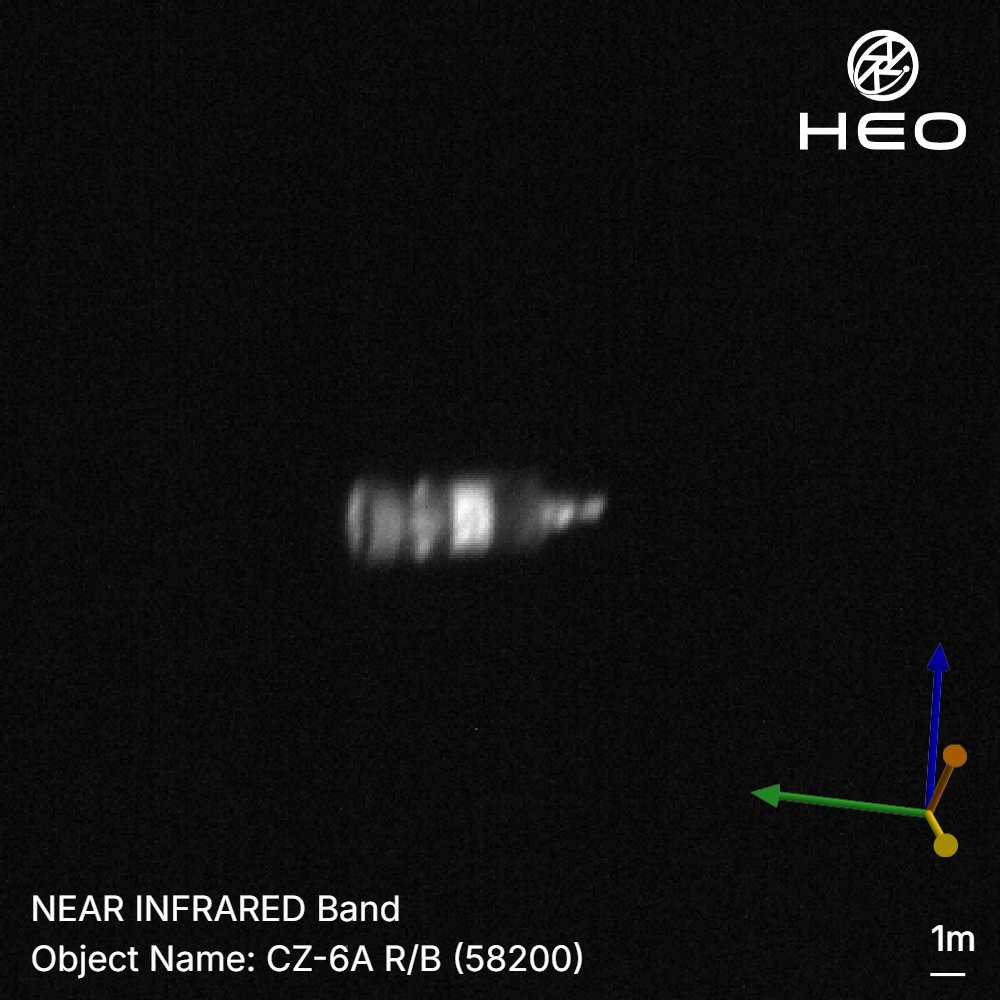
In the May 18th 2026 issue of the Integrity Flash, it was reported that, since deployments began, over thirty second-stages are still residing in orbit following their deployment tasks, most of those being of the Long March 6A. Those stages have been tracked to fly up to 900 kilometers before bringing themselves down to about 650 kilometers. Second-stages have been left there because the two mega-constellations’ satellites operational altitudes above 1,000-kilometers, and bringing them as close as a launch vehicle can in early deployment plans saves fuel and increases their longevity, while the stages can just about bring themselves away.
Jim Shell, a former U.S. Air Force Lt. Col. and now space consultant, also noted on May 26th that with second-stages remaining in orbit, China is leaving a large amount of mass and total launch vehicle objects in the low Earth orbit region, trailing Russia and the United States.
However, in deploying satellites at that altitude, Qianfan and GuoWang have so far avoided supposed ‘risky calls’ with Starlink, unlike Amazon Leo. That resulted in a series of back-and-forth complaints via regulators for deployments atop of Arianespace’s Ariane 6 and SpaceX’s Falcon 9. Starlink is the only constellation to have always released its satellites in very low orbits, thanks to SpaceX’s unique ownership of both an affordable launch vehicle and the mega-constellation.
In good news for the sustainability of deployments, as part of a regulatory overhaul, China updated its regulations for commercial space enterprises, legally binding them to deorbit stages once they have completed their tasks, including previously mentioned launches for constellation satellites. At state-owned enterprises, they continue to follow United Nations guidelines, outlined by the solving of second-stage fragmentation events, while better standards are discussed by regulators, likely to be similar to those for commercial entities once implemented.
Considering from the 1st of August 2024 to May 26th 2026.
Considering from the 1st of December 2024 to May 26th 2026.
Each Qianfan satellite weighs about 267 kilograms and can be flat-packed. GuoWang satellites weigh between 695 and 1,000 kilograms while attached to a central pillar during launch.
Considering from the 1st of April 2025 to May 26th 2026.
The closest Shanghai Spacesail Technologies has come to doing this is investing in a sea launch firm, likely as the preferred, pace-setting customer.
Those performed by the China Academy of Launch Vehicle Technology and the Shanghai Academy of Spaceflight Technology.
The north-western Jiuquan Satellite Launch Center, on the border of the Inner Mongolia Autonomous Region (内蒙古自治区 / ᠥᠪᠥᠷ ᠮᠣᠩᠭᠣᠯ ᠤᠨ ᠤᠨᠥᠪᠡᠷᠲᠡᠭᠨ ᠵᠠᠰᠠᠬᠤ ᠣᠷᠣᠨ) and Gansu (甘肃) province, the centrally north Taiyuan Satellite Launch Center, in Shanxi (山西) province, and the Wenchang Space Launch Sites on the southern island of Hainan (海南) province.