

Qianfan Operator Invests in Sea Launch to Secure Greater Space Access
Shanghai could become a hub for sea-launched connectivity satellites with the backing of major local players.

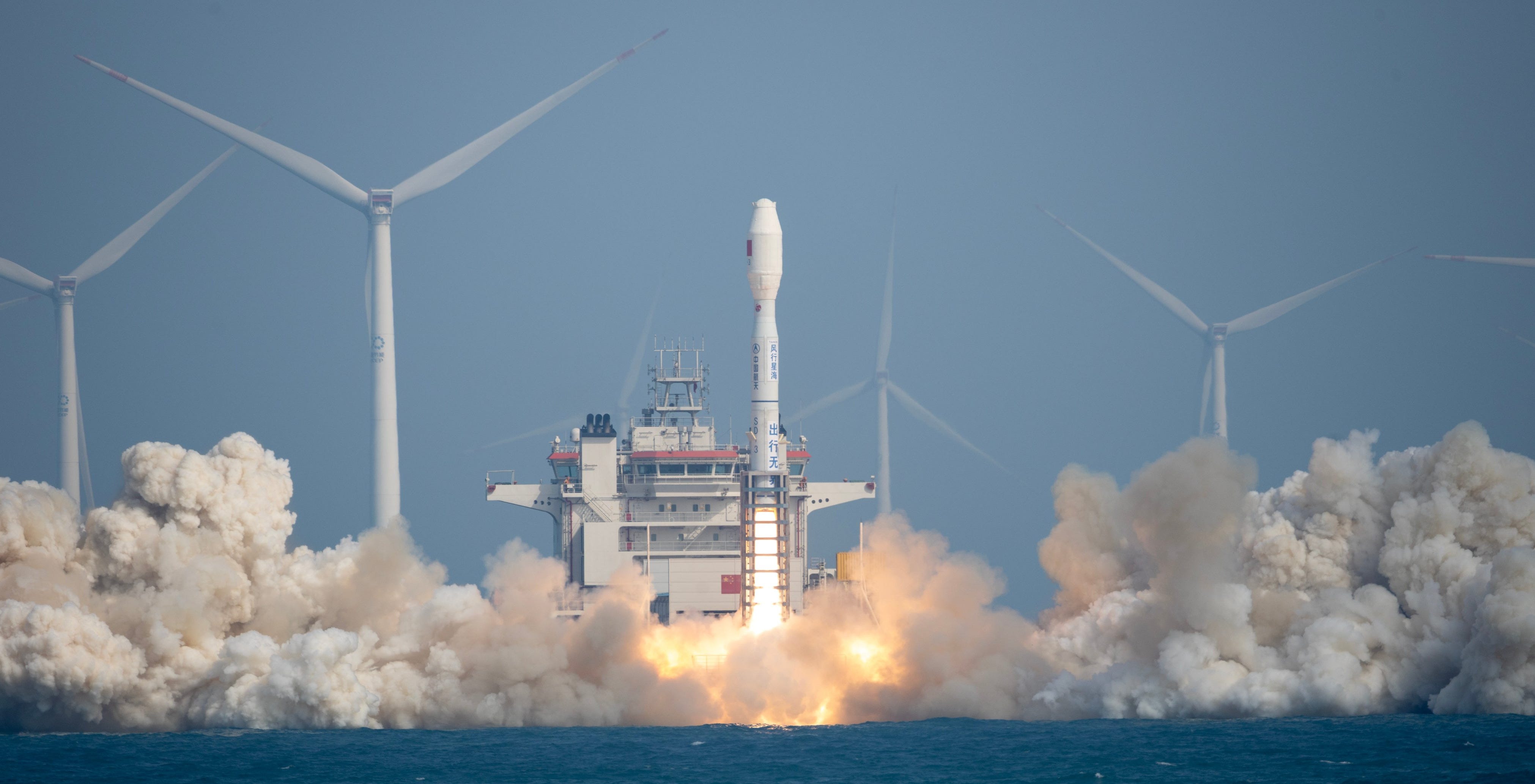
Having resumed routine deployment yesterday, the Qianfan (千帆) connectivity mega-constellation is set to gradually grow its satellite count throughout the remainder of the year and beyond. However, Shanghai Spacesail Technologies Co Ltd (上海垣信卫星科技有限公司), operator of the mega-constellation, is hoping that more frequent and affordable launches are available soon in comparison to those they have bought via Long March launch vehicles.
To fulfil that hope, the constellation operator has invested into a new firm1 known as Shanghai Commercial Aerospace Maritime Launch Technology Co Ltd (上海商业航天海上发射技术有限公司), alongside China Aerospace Science and Technology Corporation Commercial Launch Vehicle Co Ltd (中国航天科技集团商业火箭有限公司)2, Shanghai Guosheng Group Co Ltd (上海国盛(集团)有限公司)3, Shanghai Xinzhuang Industrial Zone Economic and Technological Development Co Ltd (上海市莘庄工业区经济技术发展有限公司)4, and China Offshore Engineering Equipment Technology Development Co Ltd (中国海洋工程装备技术发展有限公司)5. The five investors have reportedly enabled the firm to have around 1.1 billion Yuan (161.9 million United States Dollars, as of May 12th) in capital.
As the new firm's name suggests, as well as their investors’ respective niches, it is focused on establishing the capability to prepare launch missions near Shanghai and then perform them from nearby waters. The idea of sea launch is already a solved problem in China with regular missions from the Haiyang Oriental Spaceport (海阳东方航天港) and the buildup of a new facility near Yangjiang (阳江市)6, Guangdong (广东) province.
Regarding what launch vehicles could utilize Shanghai facilities once established, there is the proven Ceres-1S from Galactic Energy, Orienspace’s Gravity-1, and the state-owned Jielong-3, which has previously supported China’s mega-constellation efforts. For the support of mega-constellation efforts into the future, Jielong-4 is in intensive development to carry over 4,000 kilograms into low Earth orbit inside a 4.2-meter diameter fairing. The Long March 12 series, made locally in Shanghai, is also being explored for sea launches, should a platform support their commodity needs.
Back at this year’s Two Sessions (两会) in early March, Zhang Qi (张琦), a General Manager at Shanghai Spacesail Technologies and a member of the Chinese People’s Political Consultative Conference, said that the mega-constellation operator recognised the lack of frequent satellite deployment options by reusable launch vehicles in the near future. By investing in a Shanghai-based sea launch firm, the company is likely positioning itself as a priority and regular customer in the local space industry as a means to rapidly grow Qianfan’s satellite count, in a way similar to Starlink and Falcon 9.
Growing Qianfan’s satellite count will be critical to Shanghai Spacesail Technologies reputation as a reliable global partner to entities it has agreements with, like airline manufacturer Airbus and Panasonic Avionics Corporation. In Brazil, through a deal with Telebras, the mega-constellation operator is required to begin services before early 2028, although expected as soon as the fourth quarter of the year (October, November, December), depending on the number of satellites in operational orbits. Approval of Qianfan services elsewhere around the world are progressing too, with agreements for Malaysia, Kazakhstan, and Türkiye.
Providing about 200 million Yuan (29.4 million United States Dollars) for an 18.18% stake.
A state-owned enterprise under the China Aerospace Science and Technology Corporation, working on new launch site facilities as well as reusable launch vehicles like the Long March 12B. Providing about 250 million Yuan (36.8 million United States Dollars) for an 22.73% stake.
A Shanghai government-owned capital investment firm for supporting enterprises of interest based in and around the city. Providing about 300 million Yuan (44.1 million United States Dollars) for an 27.27% stake.
A Shanghai government-owned developer supporting the further establishment of a ‘rocket city’. Providing about 150 million Yuan (22 million United States Dollars) for an 13.64% stake.
A state-owned enterprise focused on marine engineering equipment, technology, and solutions. Also providing about 200 million Yuan (29.4 million United States Dollars) for an 18.18% stake.
Some sea launches already take place offshore from Yangjiang to fly into more polar orbits, but require launch vessels to sail with their launch vehicles, with payloads integrated, for several days.