

Reusable Long March 10B Has Been Stuck on the Ground Ahead of Debut
Bad hydraulics at Commercial Launch Pad 2 have delayed the new launch vehicles first flight for several weeks, along with other operational rockets.

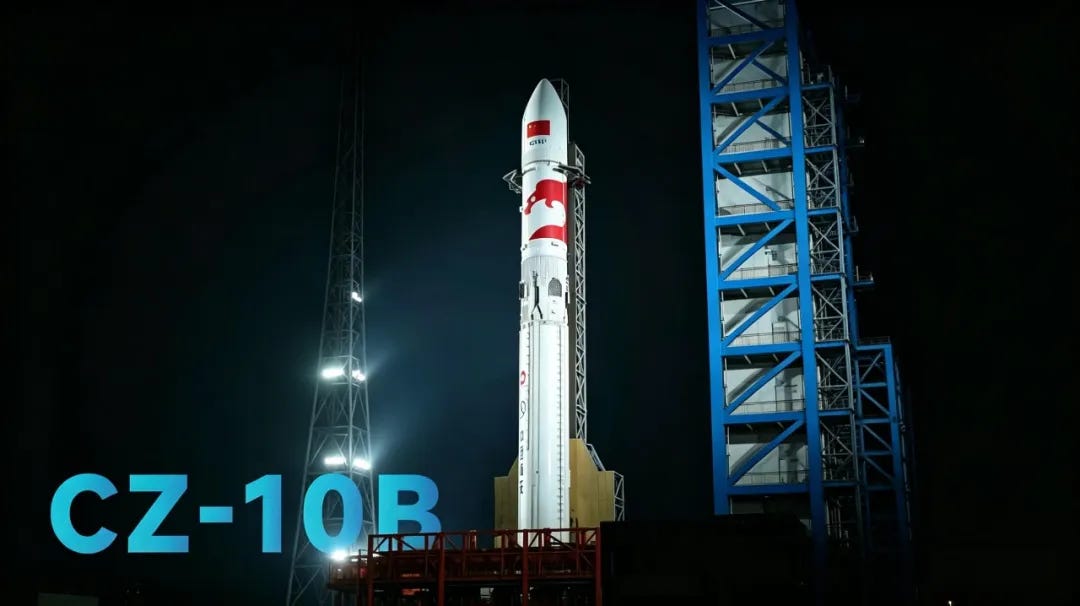
At the Wenchang Commercial Space Launch Site, the China Academy of Launch Vehicle Technology-built Long March 10B, commercialized by China Long March Rocket Co Ltd (中国长征火箭有限公司), has completed effectively all available tests, short of flying for the first time, back in April.
Its debut flight is set to demonstrate recovery of its YF-100K-powered five-meter-diameter reusable first-stage, and its liquid oxygen and liquid methane-fueled second-stage. That first-stage is almost completely identical to the also soon-to-debut Long March 10A’s, except for second-stage interfacing hardware, with the Long March 10B ‘buying down’ some risk for China’s crewed lunar landing program, as the latter will start the Mengzhou-1 mission later this year.
Preparations to fly began not long after April’s tests were wrapped up, with the launch vehicle heading back to its horizontal integration facility to receive a payload ahead of a launch as early as April 28th, based on hazard notices at the time.
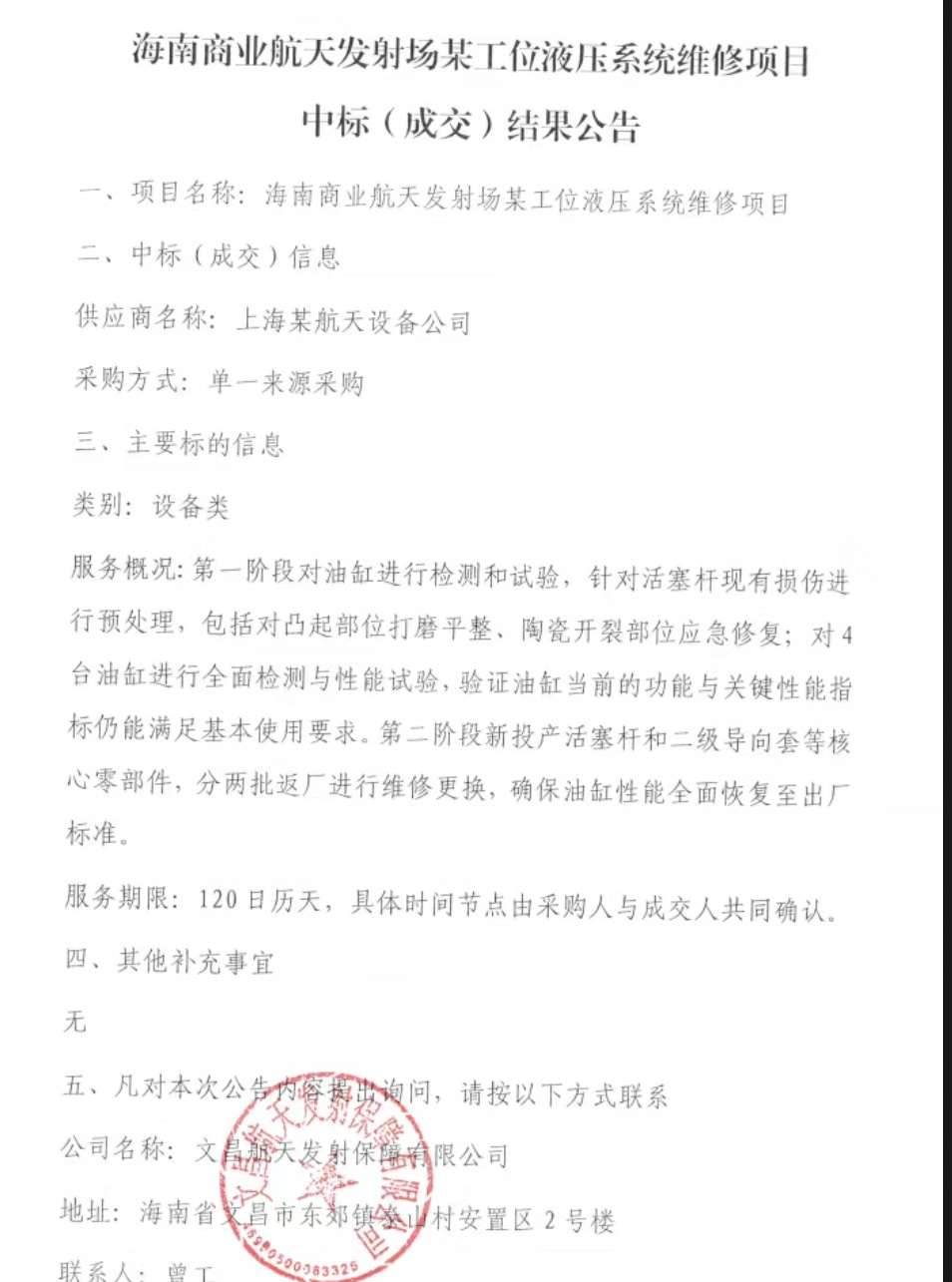
However, those notices were cancelled a few days before the expected date. Around the same time, Hainan International Commercial Aerospace Launch Co Ltd (海南国际商业航天发射有限公司), operator of the launch site, quietly put out a notice1 that a ‘certain company’ based out of Shanghai (上海市), that specializes in aerospace equipment, had won a contract to repair hydraulic cylinders and pistons in less than four months at a ‘certain workstation’2. A notably critical system using the mentioned hardware at the site is Commercial Launch Pad 2 for moving a launch vehicle transporter-erector upright3, which was upgraded to support the Long March 10B.
Supporting that this is an issue with Commercial Launch Pad 2, the Long March 8 series dedicated Commercial Launch Pad 1 has continued to support satellite deployments uninterrupted. Additionally, if a vehicle issue was delaying the Long March 10B, the smaller Long March 12 would have flown several times in the previous months. Instead, the vehicle flew in mid-January, then waited five months to fly again yesterday, June 17th. That flight may have verified repairs too, although the Long March 12’s transporter erector does not require the use of all installed pistons to upright it.
Despite that preparations to fly the Long March 10B continutes, as indicative of a pending flight and landing attempt is that the autonomous Long March 10 series booster-catching ship ‘Linghangzhe (领航者)’ has sailed from Shantou (汕头市), Guangdong (广东) province, to Sanya (三亚市), on the southern coast of Hainan (海南) province, and a short trip from the Wenchang launch sites and expected recovery zones to the south east. Final trials and system verifications of the vessel have been underway since joint rehearsals with the Long March 10A test booster in February.
Another item supporting that the Long March 10B is being prepared to fly soon is a media tender from the China Academy of Launch Vehicle Technology for unmanned maritime aerial photography, as in at sea with a drone to photograph first-stage booster recovery on ‘Linghangzhe’.


China Long March Rocket Co Ltd4 is eager to get the Long March 10B flying in order to compete with China Aerospace Science and Technology Commercial Launch Vehicle Group Co Ltd5 and its recently debuted to-be-reusable Long March 12B.6
Elsewhere with reusable systems up north, Galactic Energy has recently placed its first Pallas-1 launch vehicle on its launch pad at the Jiuquan Satellite Launch Center, and LandSpace’s second Zhuque-3 is nearly ready to begin its second launch campaign, with some hardware departing in April, and other items have been delivered in recent days. At a United Nations event in February, a LandSpace official said that the second launch was expected between April and June, so they appear to be within their schedule to re-fly a first-stage booster before year’s end, assuming all goes well.
Since removed from their online archives, but here is a copy of it:
How the launch site operator refers to its launch pads.
Visible in this video of systems tests for iSpace’s Hyperbola-3 launch vehicle in February:
A subsidiary of the China Academy of Launch Vehicle Technology.
Owned by the China Aerospace Science and Technology Corporation and supported by the Shanghai Academy of Spaceflight Technology and the China Academy of Launch Vehicle Technology.
The Shanghai Academy of Spaceflight Technology and the China Academy of Launch Vehicle Technology have historically competed by operating similar launch vehicles, for example, the not-related Long March 2C and Long March 2D (part of the Long March 4 series), to drive down prices. Both enterprises are owned by the China Aerospace Science and Technology Corporation and can mandate that they work together on projects like the Long March 5 series.