

Shenzhou-21 Taikonauts Back on Earth Following Seven Month Mission
With 210 days spent onboard the Tiangong Space Station, a return journey back home took only three orbits via the Shenzhou-22 spacecraft.

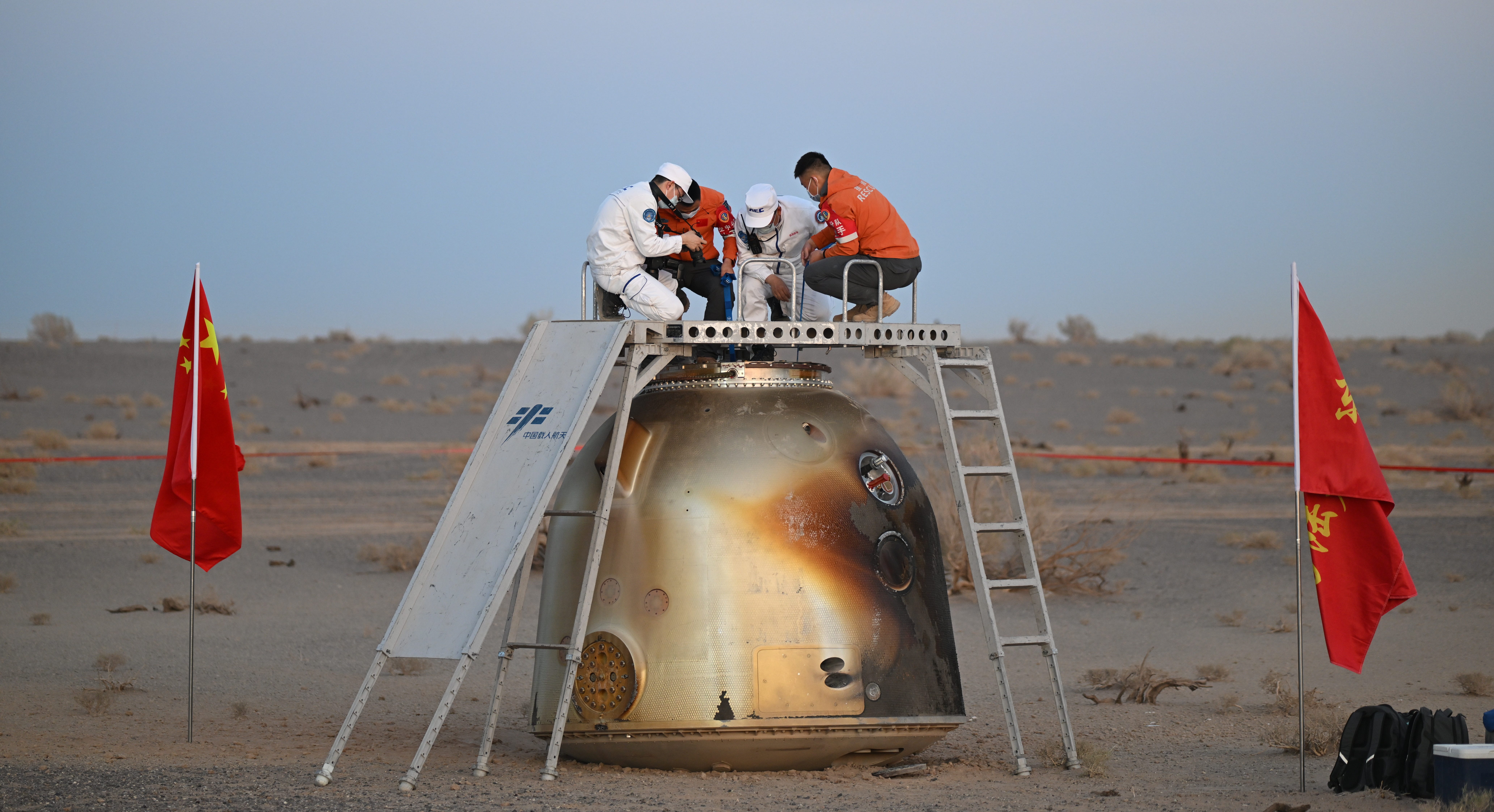
To prepare to return to Earth today, Zhang Lu (张陆)1, Wu Fei (武飞)2, and Zhang Hongzhang (张洪章)3 boarded the Shenzhou-22 spacecraft4 to start their day, shutting the hatches to the Tianhe modules’ forward docking port and removing air between them. Once it was confirmed safe to do so, the spacecraft departed from the Tiangong Space Station at 14:44 pm China Standard Time (06:44 am Universal Coordinated Time), starting the three-orbit process of deorbiting.
Two of those were used to lower the Shenzhou-21 spacecraft’s orbit, to gain distance from Tiangong and to align a predetermined reentry path. On the third orbit, the spacecraft’s orbital module was jettisoned, with the engines igniting to bring itself out of orbit, followed by service module separation. The reentry module, with the three taikonauts inside, went through reentry over a dozen minutes, then falling through the atmosphere before the drogue and main parachute deployment for a slow descent. An upright touchdown to the end of the mission occurred at 20:11 pm China Standard Time (12:11 pm Universal Coordinated Time) on May 29th.
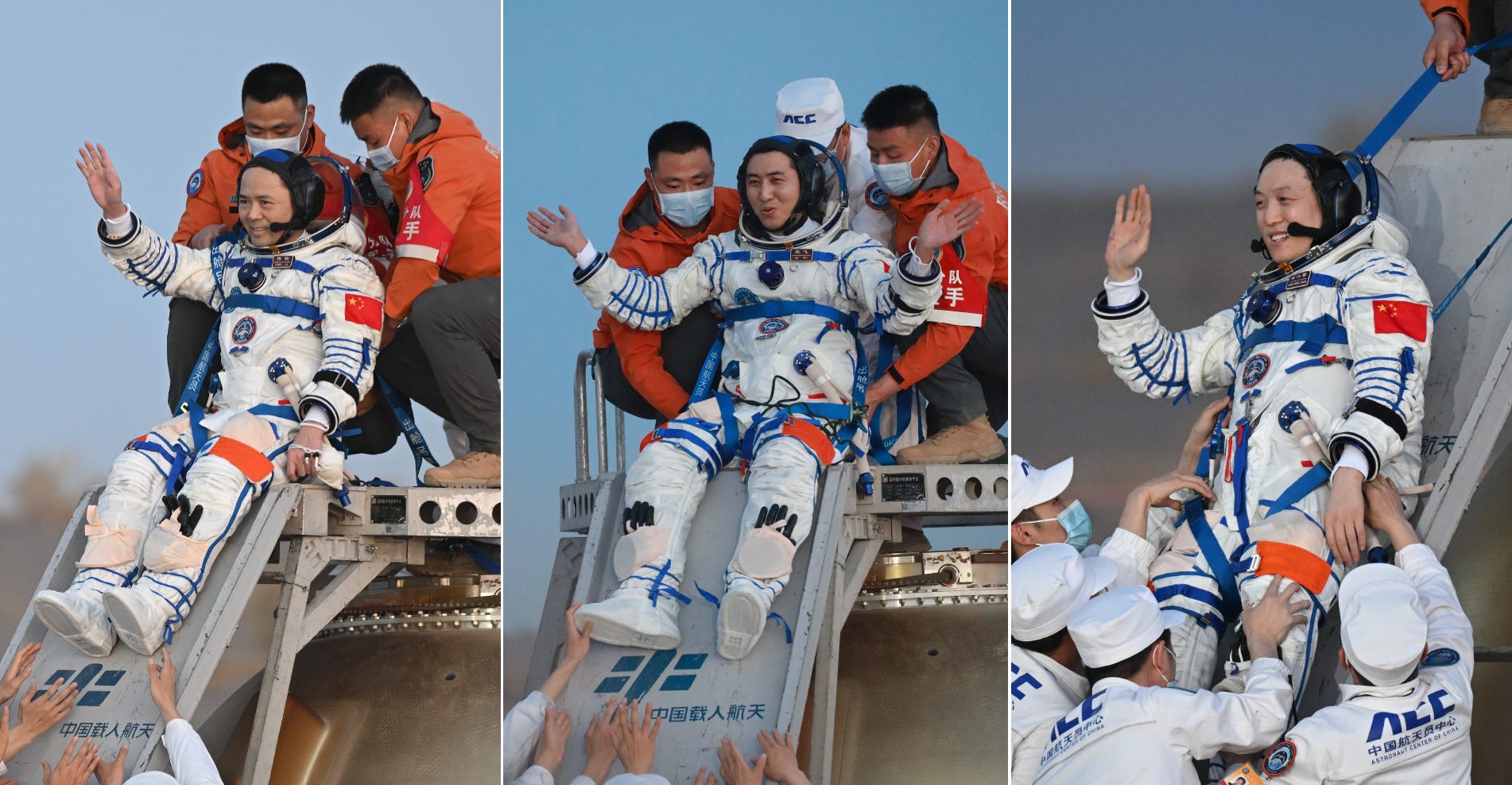
Following extraction from the spacecraft, the Shenzhou-21 crew briefly spoke to the media, sharing:
Zhang Lu: “Once again, I’m back home, back to the motherland. The Shenzhou-21 crew was in orbit for seven months, and we couldn’t have done it without the care of our families and our comrades, nor could we have done it without the leaders at all levels and colleagues on the projects. We could not have done it without the support of the motherland and the people. Actually, this is one person’s sea of stars, but a group of people’s loyalty.”
“I have a gift for everyone, actually. On the day of the launch of Shenzhou-21, the ground team gave us an apple to wish us a safe and smooth mission. Our safety is their greatest wish. Tomorrow is May 30th, National Science and Technology Workers Day, so when leaving the space station we brought back an apple to give to all of the sci-tech workers, and to say that you have worked hard. At the same time, we wish our space industry prosperity and for every mission’s safety and success.”
Wu Fei: “Back to Earth, back to the embrace of the motherland. I feel extremely proud and grounded, for this was my first mission. With the trust of our motherland, the guidance of our predecessors, and the joint efforts of the entire crew, allowed me to successfully fulfill the mission. And the mission has also made me even more deeply understand even more the most beautiful views of the country. I would like to take this space mission as motivation to move forward and make my contributions to human spaceflight.”
Zhang Hongzhang: “From the ground laboratory to China’s space station, our great nation helped to enable me to realize my scientific ideals and integrate my space dreams. With the support of the entire team and the assistance of scientific researchers and everyone’s care, we as a crew have completed all of our allocated science research projects. For the first time, small mammals were successfully bred in orbit and the space vegetable garden is also thriving with a great variety of produce. Also, the in-situ research on lithium-ion batteries, new optics, and electrochemistry has yielded valuable scientific data from space.”
“Looking at the Earth, I felt that humanity is an inseparable community with a shared future. Now I’m back on Earth, back in my motherland, I feel incredibly grounded and warm. Going forward, I will carry the abundance of my harvest and continue to make contributions into building China into a space power.”
In a few hours, after initial medical checks, the three taikonauts will be flown to Beijing (北京) for comprehensive post-mission checks and adjustment back to life on Earth. All three crew members spent 210 days onboard the Tiangong Space Station.
While onboard Tiangong for seven months, the longest of a Shenzhou mission to thanks to extra supplies delivered by Shenzhou-225, Zhang, Wu, and Zhang have participated in medical experiments, enabled research into brain function, supported the development of new battery technologies, as well as observing how small mammals adapt and breed in space. Alongside that, Zhang Lu and Wu Fei performed three spacewalks, spending about twenty and a half hours outside, to install space debris protection devices. The crew also kicked off the space station’s fifth art exhibition in April.
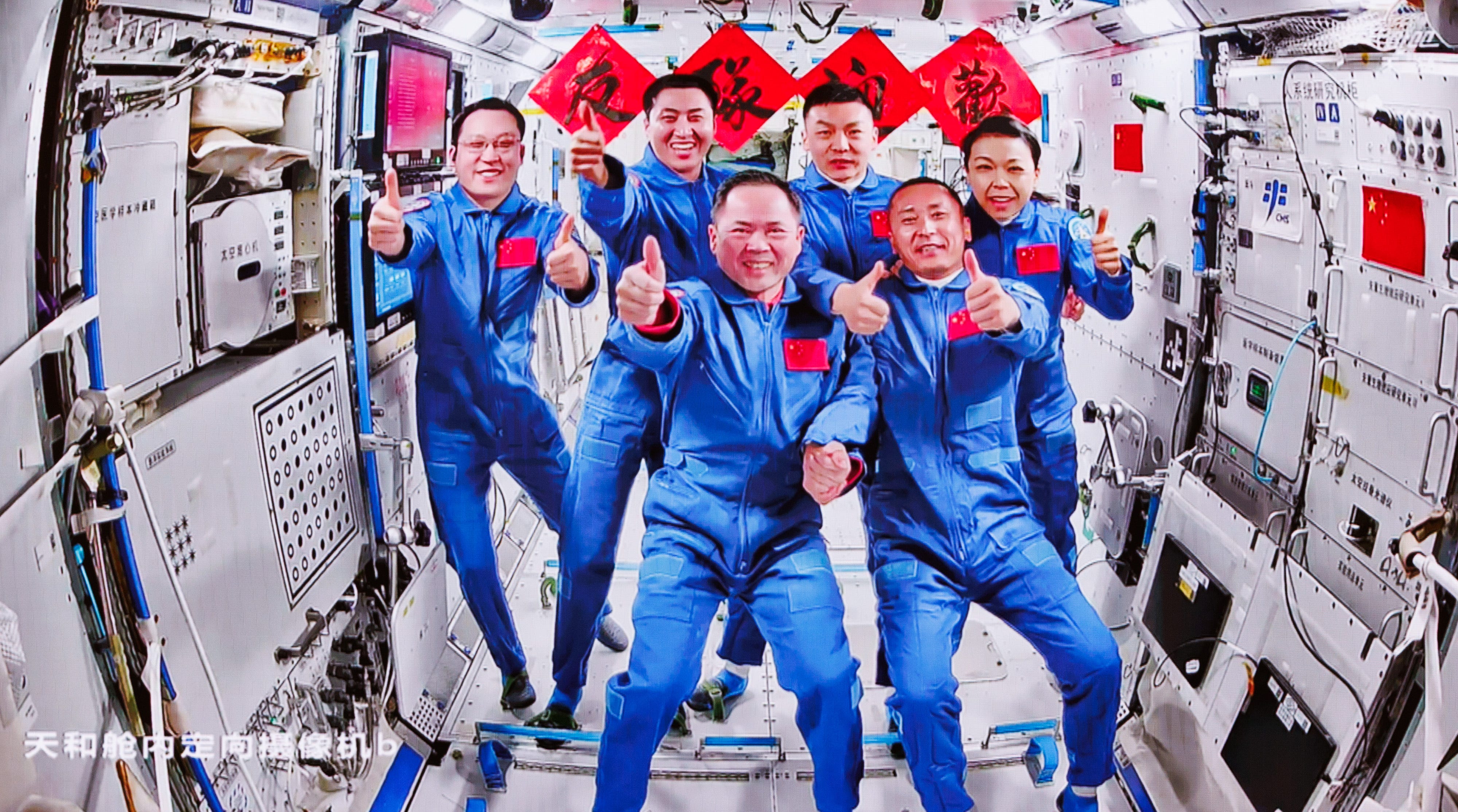
Ahead of their departure from Tiangong, the Shenzhou-21 trio welcomed Shenzhou-23’s Zhu Yangzhu (朱杨柱)6, Li Jiaying (黎家盈)7, and Zhang Zhiyuan (张志远)8 on May 25th, after a launch hours prior. The two crews spent about three days working with each other, with the new trio primarily tasked with adapting to microgravity and performing monitoring experiments related to it. On May 28th, Shenzhou-23’s taikonauts were symbolically handed the keys to the space station and had responsibility for it signed over to them.
Over the next six months, the new crew is expected to support experiments in areas like pace life sciences, material sciences, fluid behaviour in microgravity, space medicine, and new technology verification. Some known ones, of the stated over one hundred, include observations of embryos of zebrafish, mice, and stem cell-derived artificial human ones, testing of crop seeds, biocatalytic materials, microbial samples, as well as experimental lunar fibers and thin, flexible solar cells. Two of the taikonauts will also venture outside at least once to install a greenhouse gas monitoring instrument from the Hong Kong University of Science and Technology (香港科技大学).
Additionally, one member of the Shenzhou-23 crew is remaining onboard Tiangong for the next twelve months, for the first full year stay in space by a taikonaut, as part of extensive research into human health in microgravity. That stay is also enabling a brief visit by a Pakistani astronaut toward the end of the year.

Zhang Lu is the Commander and Pilot of the mission for his second spaceflight, having flown for the Shenzhou-15 mission between November 2022 and June 2023. He is from Hanshou County (汉寿县), Hunan (湖南) province, and was selected as part of China’s second taikonaut group in 2010, also being considered a ‘post-70s’ taikonaut having been born in November 1976.
Before becoming a taikonaut, Zhang served in the People’s Liberation Army Air Force and achieved the rank of Senior Colonel. He also joined the Communist Party of China in April 1999. After the Shenzhou-15 mission, Zhang was awarded the Spaceflight Merit Medal (Third Class) along with the honorary title of hero taikonaut.
Wu Fei is the Flight Engineer for this mission, which will be his first trip into space. He is from Baotou (包头市 / ᠪᠤᠭᠤᠲᠤᠬᠣᠲᠠ), in the Inner Mongolia Autonomous Region (内蒙古自治区 / ᠥᠪᠥᠷ ᠮᠣᠩᠭᠣᠯ ᠤᠨ ᠤᠨᠥᠪᠡᠷᠲᠡᠭᠨ ᠵᠠᠰᠠᠬᠤ ᠣᠷᠣᠨ), and was selected as part of the third taikonaut group in October 2020, while being considered a ‘post-90s’ taikonaut having been born in 1993.
Before his selection as a taikonaut, Wu was an engineer at the China Aerospace Science and Technology Corporation. He also joined the Communist Party of China in 2015.
Zhang Hongzhang is the Payload Expert for this mission, with it being his first trip to space. He is from Binzhou (滨州市), Shandong (山东) province, and was also selected as part of the third taikonaut group in October 2020, while being considered a ‘post-80s’ taikonaut having been born in 1986.
Prior to being selected as a taikonaut, Zhang was a researcher at the Dalian Institute of Chemical Physics, Chinese Academy of Sciences (中国科学院大连化学物理研究所), where he explored new materials and technology for batteries. He also joined the Communist Party of China in 2004.
The Shenzhou-21 crew has the Shenzhou-22 spacecraft, which launched without crew, following a space debris strike to the Shenzhou-20 spacecraft, with the Shenzhou-20 crew taking the Shenzhou-21 spacecraft home.
See note four.
Commander of the mission for his second spaceflight, having flown as part of the Shenzhou-16 mission, for 153 days from May 30th 2023 to October 31st 2023. Born in September 1986, he is from Peixian (沛县), in Jiangsu (江苏) province, and was selected as part of China’s third taikoanut group in 2020.
Before becoming a taikonaut, he worked as an Associate Professor of aerospace engineering within the People’s Liberation Army, where he achieved the rank of Colonel. Since December 2006, Zhu Yangzhu has been a member of the Communist Party of China. He has been awarded the title of ‘Heroic Astronaut’ too.
Mission Specialist for the mission, she is flying for the first time following selection as a fourth batch taikonaut in 2024. Born in November 1982, she is from the Hong Kong (香港) Special Administrative Region.
Prior to being selected, she was a Chief Inspector of the Hong Kong Police Force, reaching the rank of Superintendent, and holds a PhD in computational and information science-related subjects.
Spacecraft Pilot of the mission, he is in space for the first time after being selected as part of the third group in 2020. Born in June 1986, he is from Gansu (甘肃) province.
Before being selected as a taikoanut as part of the third group, he served in the People’s Liberation Army Air Force as a pilot, where he achieved the rank of Colonel. He has been a member of the Communist Party of China since 2011.