

Ramifications of Long March 7A Failure to Be Clear Soon
The modern Long March family of launch vehicles may have gotten away without much consequence.

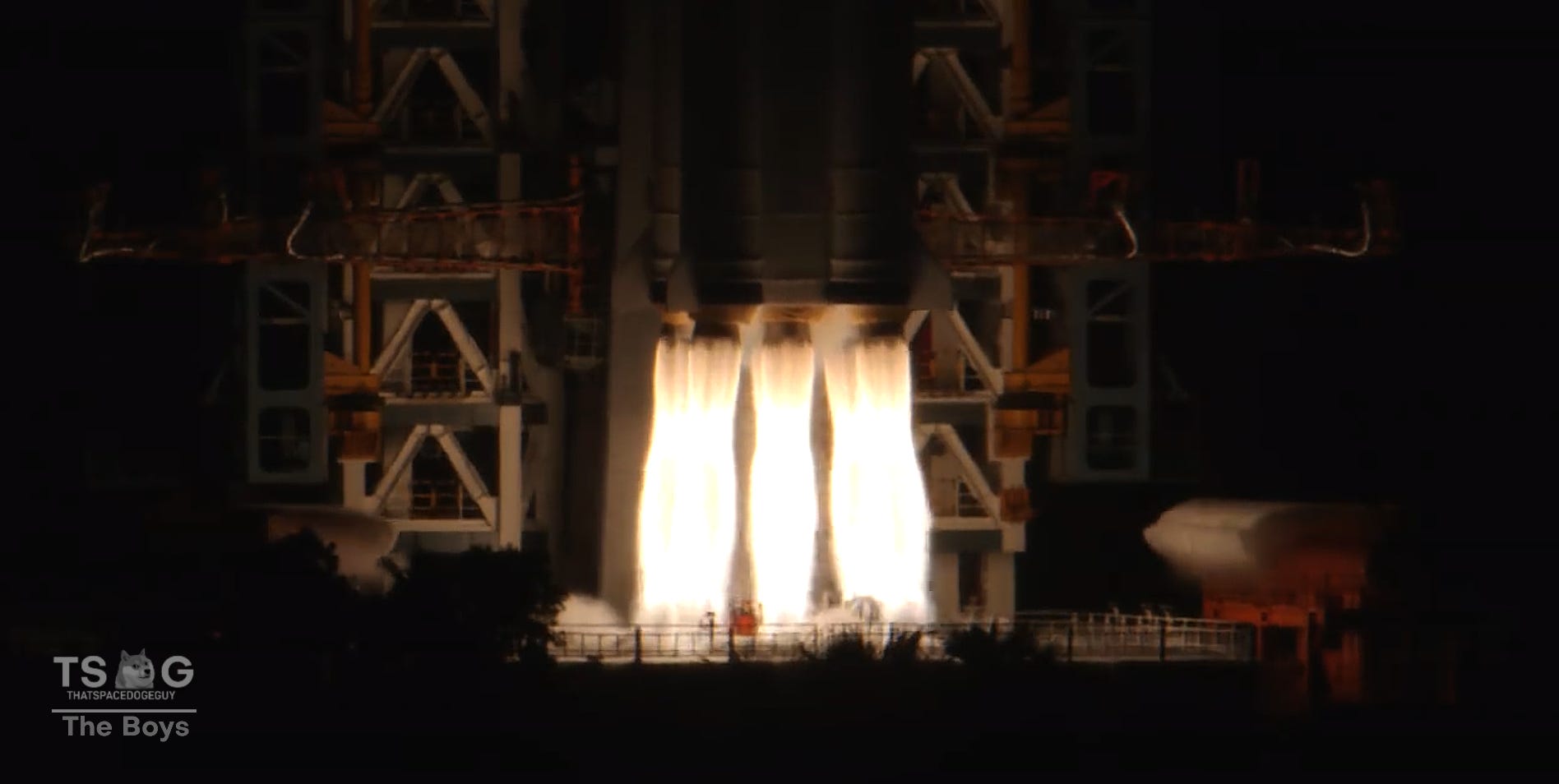
It was a long night at the Wenchang Space Launch Site following the failure of the Long March 7A with ChinaSat-4B (中星4B卫星) on August 10th. Immediately after the launch vehicle’s fireball disappeared from mission control screens, engineers on site began collecting data for a thorough investigation, which was already in the process of being organized within the wider China Aerospace Science and Technology Corporation1.2
That investigation will be ongoing for several months to determine the ultimate cause, concluding in various hardware changes to prevent the issue from appearing again. In the days since the failure, some information about what components were the probable cause has started to become evident.
‘The front fell off’3
It did not take long for scourers of the web to find an array of footage captured by observant tourists as well as one leaked from feeds available to engineers within the launch site.
Collected footage shows4 that the third-stage of the Long March 7A falls off either its inter-stage or the lower propellant tank, where the much denser liquid oxygen is kept. As an immediate result the stage, bringing the payload fairing and ChinaSat-4B with it, slams into the second-stage and causes itself to detonate the light-but-voluminous liquid hydrogen.
Secondary to the third-stage falling off, the six YF-100 engines attempt to maintain control before one on the first-stage shut down early, possibly due to an external propellant line being damaged by the nearby explosion. The five remaining engines keep burning for a few more seconds, utilizing the never-before-needed engine-out capability, until the flight termination system computes the amount of data no longer coming in, alongside actively drifting off the planned trajectory, and detonating the remainder of the launch vehicle.


It’s unclear what caused the third-stage to fall off or apart, but leading theories from several sources indicate a quality control mishap5 or unaccounted-for harsh winds, maybe a mixture of both. Weather being the cause would be odd, as the Long March 3B/E, which uses the same third-stage, flew through a thunderstorm just weeks ago, getting hit by lightning in the process.
It is necessary to note that in the half dozen Long March 7A missions between September 2025 and this July, the launch vehicles’ structures have been ‘optimized’ to gain extra performance for sending payloads towards medium Earth and geostationary orbits. ‘Optimizations’ to control systems had been made too.
Worth mentioning as well is that before the recent loss of the Long March 7A, about 470 YF-100 series engines have been used without major issues, culminating in many dozens of hours of flight time.
Additionally, before and after the Long March 7A failure, hazard notices for a Long March 12 mission no earlier than August 16th have remained active, indicating no expected impact. That is significant here as the vehicle’s first-stage uses four uprated YF-100’s, known as the YF-100K, on its first-stage.
If used without issue in the coming days, that launch would further clear a handful of other vehicles to resume flights. Those are the Long March 6, Long March 6A, Long March 6C, Long March 8, Long March 8A, Long March 7, Long March 5B, and the Long March 5. The final one is set to launch the internationally involved Chang’e 7 robotic mission to the Moon, which the Deep Space Exploration Laboratory (深空探测实验室) expects to begin as previously planned.
An unfortunate year for geostationary programs
Earlier this year, the legacy half of the Long March family had a major failure too, when the Long March 3B/E was lost due to a third-stage issue in January. That third-stage is also shared with the Long March 7A.
Unlike the recent launch failure, the Long March 3B/E’s failure was caused by the stage during its portion of ascent into a parking orbit, which it did not meet and fell into the southern Pacific. The stage took three months to be cleared for flight, returning in April via a Long March 8.
Both the Long March 7A and Long March 3B/E are China’s workhorse launch vehicles for reaching geostationary space, having conducted all but one mission to orbital regime so far this year. The latter has flown twice after its January failure.
With the third-stage out of use for several months once again, several geostationary satellite programs will have their upcoming missions halted. Those affected include ChinaSat (中星) communications, next-generation Tianlian (天链) relays, the technology verifying TJSW (通信技术试验卫星) series, as well as a handful of experimental Shiyan (实验) and operations proving Shijian (实践) designated spacecraft, among others.
Depending on how urgently program managers would like new spacecraft to be deployed, other launch vehicles can be procured. Lighter ones can be moved over to the ever more available Long March 8A. Larger satellites could be dual-manifested onboard the Long March 5, housed within its extended fairing and an ECA-like structure where one spacecraft is sat above the other.
Who own both the manufacturer of the launch vehicle and the operator of the lost spacecraft.
Details in this paragraph have come from China in Space’s sources where not otherwise linked.
In reference:
Some of which is public (see the tweet embedded below).
For hardware or onboard software.